Texas has never had a simple water story.
The state has rivers, reservoirs, aquifers, a long coastline and some of the country’s most sophisticated water infrastructure. It also has vast geographic differences in rainfall, recurring drought, rapidly growing cities and regions where the water supply has been under pressure for generations.
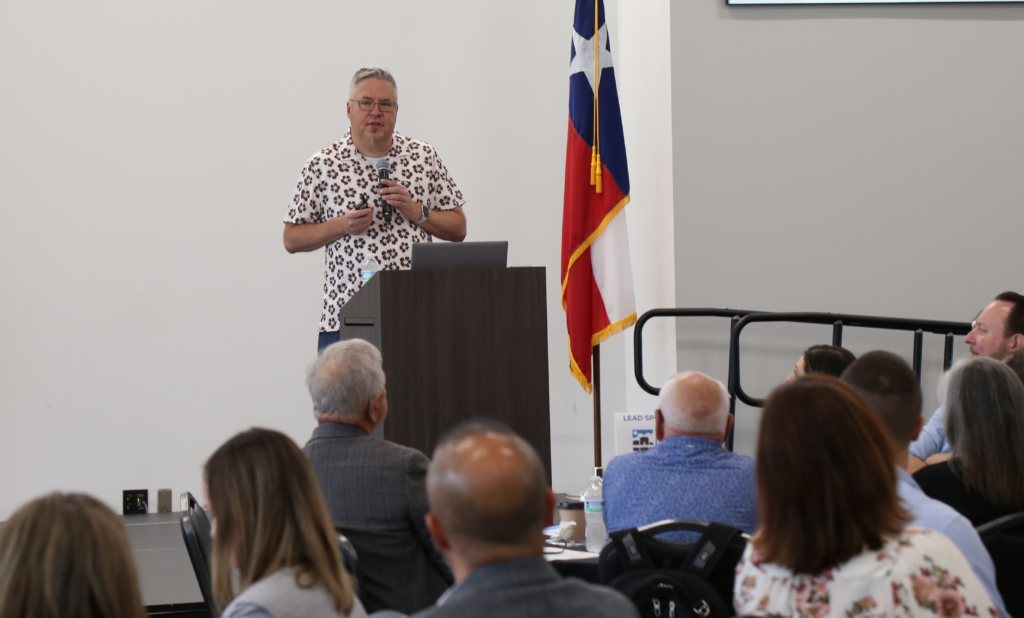
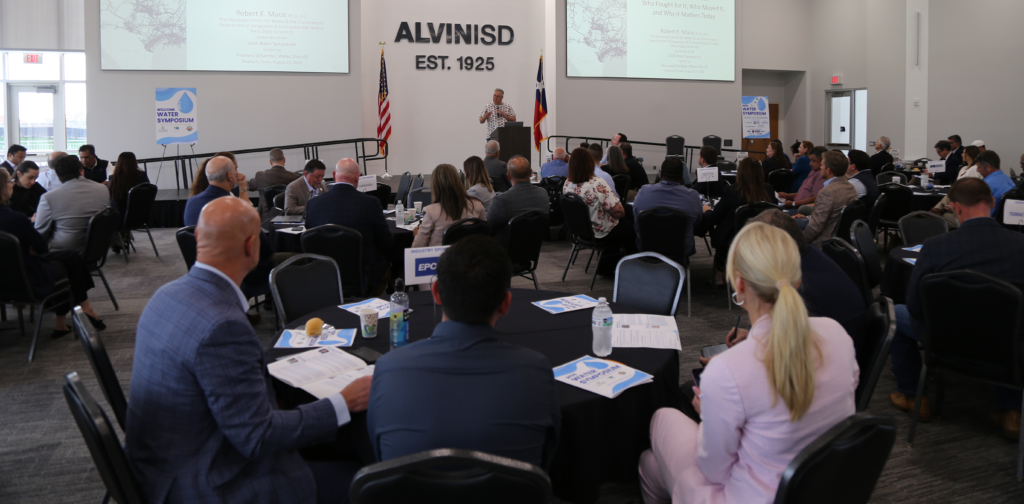
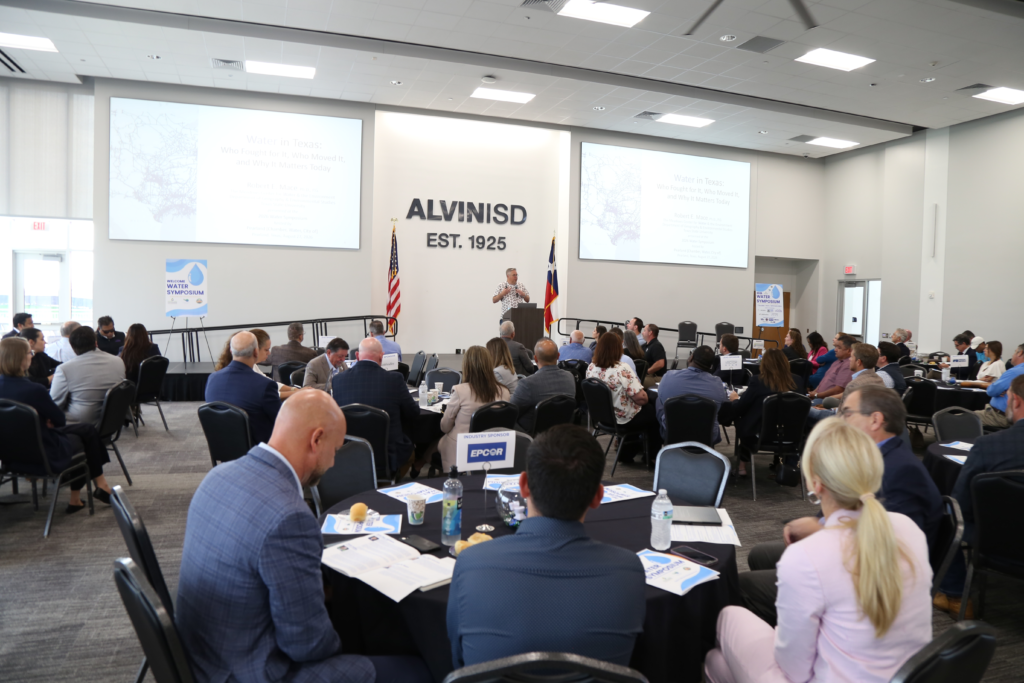
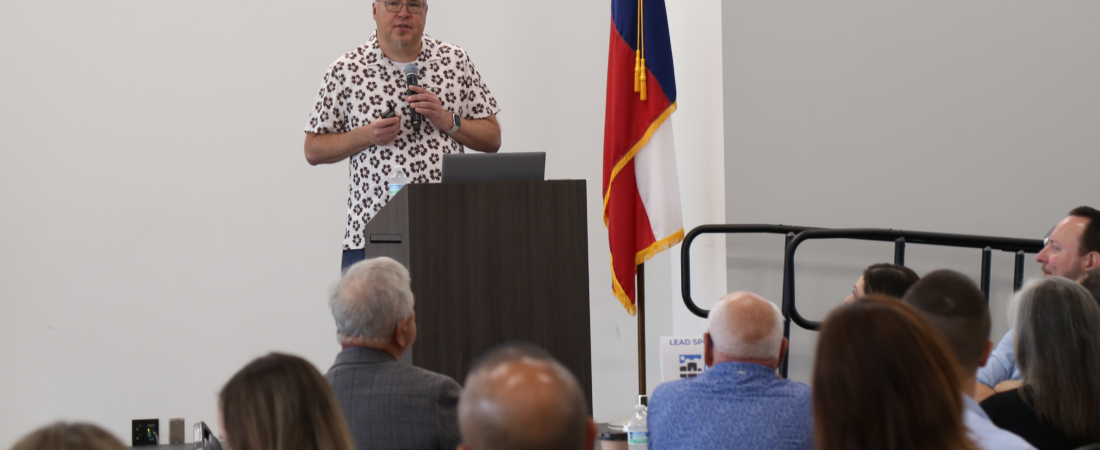
That history was the focus of the keynote presentation at the Pearland Chamber of Commerce’s 2026 Water Symposium, where Robert Mace, Ph.D., executive director and chief water policy officer for The Meadows Center for Water and the Environment, traced the long list of ideas Texans have considered when local water supplies no longer feel sufficient.
Some were practical. Some were enormous. Some were so ambitious that they could sound like science fiction today.
But the point of looking backward, Mace told the audience, was not to celebrate old engineering schemes. It was to understand how water challenges have shaped Texas and why the state may once again face difficult decisions about drought, infrastructure and moving water long distances.
“Water is not one of those issues we can afford to think about five years from now,” the symposium’s opening remarks said. “Every home we build, every business we recruit, every program we grow, and every new technology we bring to this region depends on one thing we often take for granted, having enough water in the right place at the right time.”
A state built around uneven water
Mace began with the fundamental reality behind Texas water policy: Water is not distributed evenly across the state.
East Texas has more rainfall, rivers and forested watersheds. Central Texas has experienced dramatic population growth and increasing demand. West Texas has long faced scarcity, particularly in areas dependent on the Ogallala Aquifer. Along the Gulf Coast, communities must balance surface-water supplies, groundwater management, subsidence, industrial demand, agriculture and growing populations.
For generations, one of the most difficult challenges has been the declining Ogallala Aquifer, which supports much of the High Plains. Mace explained that groundwater has been pumped from portions of the aquifer at a much faster rate than it can be replenished naturally.
That created pressure to look elsewhere for water.
As early as the 1930s, Texans were considering whether large reservoirs, canals and pipelines could move water from wetter areas into drier parts of the state. The question was never whether engineers could build the infrastructure. The question was whether the projects could be financed, permitted and politically supported.
The era of big ideas
Mace walked the audience through several historical proposals, including plans that would have dramatically changed Texas’ water geography.
One of the better-known ideas was a mid-century proposal often referred to as “Burleson’s Ditch,” named for a federal reclamation official involved in the planning. The proposal envisioned a major canal running along the Gulf Coast and distributing water from East Texas river basins to other regions of the state.
The project would have been immense. Mace described a canal hundreds of miles long, approximately 200 feet wide and 15 feet deep, designed to carry millions of acre-feet of water annually.
Texas’ 1968 state water plan took the concept further. It included proposals to bring water from the Mississippi River into Texas through an extensive network of pipelines, canals and reservoirs. Maps from that period showed routes extending across North Texas and into West Texas, with connections intended to support communities and agriculture far from major water sources.
The numbers were enormous even by modern standards. One plan would have required roughly 1,400 miles of pipelines and 71 pumping stations. The estimated cost at the time was $6.3 billion in 1968 dollars, which Mace said would be roughly equivalent to $62 billion in 2026 dollars before accounting for the additional cost and complexity of modern permitting, property acquisition and environmental compliance.
The plans were ambitious, but they did not move forward.
A 1969 bond proposal intended to finance part of the water-importation project failed statewide. Mace noted that even some of the High Plains communities the project was meant to help voted against it. Houston voters also opposed the proposal. The lesson, he suggested, is that water projects can make technical sense while still facing overwhelming financial and political hurdles.
The Mississippi, Canada and Alaska
The Mississippi River has appeared repeatedly in Texas water discussions because of its enormous flow compared with the state’s rivers.
Mace said the Mississippi’s average annual flow is many times larger than Texas’ total surface-water flow. That has made it an obvious target for people looking at ways to supply the High Plains, North Texas and other drought-prone regions.
But getting Mississippi River water to Texas would mean more than building a pipe.
The project would require agreements with other states, federal approvals, major rights-of-way, enormous energy inputs and customers willing to pay for costly water. Even if the river’s water is technically available, the states and communities along its route are unlikely to welcome a large Texas water diversion without their own protections and benefits.
Mace also described even more ambitious proposals involving Canada and Alaska.
The North American Water and Power Alliance, commonly known as NAWAPA, was a mid-20th-century concept that would have redirected water from Alaska and Canada through a massive system of dams, reservoirs, canals and pipelines. It was intended to serve the western United States, Canada and Mexico.
The scope was staggering. Mace said the plan envisioned one reservoir roughly 500 miles long, a dam approximately 1,700 feet tall and water transfers across international borders. The estimated cost in the 1960s was $100 billion, or about $1.1 trillion in 2026 dollars, before considering the modern realities of environmental review, cross-border diplomacy and construction costs.
The project was never close to becoming reality. Still, it illustrates how far water planners have been willing to think when drought and growth create anxiety about the future.
Mace’s point was not that Texas should expect Canadian water to arrive in a pipeline. It was that history offers a reminder: When communities fear they may run out of water, ideas that once seemed impossible return to the table.
The drought question
Much of Mace’s presentation returned to drought, especially the danger of planning only for the droughts Texas has already experienced.
The state’s current water-planning framework uses the drought of record as a benchmark. But Mace said the drought of record is, by definition, only the worst drought observed so far. It does not guarantee that a more severe drought will not happen.
He used Corpus Christi as a case study.
Corpus Christi is served by several surface-water sources, giving it a more diverse portfolio than some Texas cities. Yet the region still approached a water crisis in recent years when drought drove major reservoirs to historically low levels.
Mace showed how the city’s reservoir system has faced repeated drought-of-record conditions over the decades. In the Nueces River Basin, he said, the community has experienced multiple new droughts of record since the late 1950s. That matters because planning standards can be met and still prove insufficient when conditions become more severe than the assumptions behind the plan.
For Mace, the lesson is not that surface water is unreliable in every situation. It is that cities dependent on surface water need backup supplies and should think through what happens if rivers, reservoirs or contractual supplies become less reliable.
“What would you do if this went away?” was the question underlying his presentation. “And how quickly could you stand up a project to supplement that lost water?”
Those are difficult questions because water infrastructure takes time. Reservoirs, desalination plants, pipelines, treatment facilities and major reuse systems can require years or decades to plan, finance, permit and build.
Why expensive water may still matter
One of the realities of long-term water planning is that new supply often costs more than the water communities use today.
Mace discussed seawater desalination, brackish groundwater desalination, reservoirs and rainwater harvesting as examples of supplies with widely varying costs. Seawater desalination may cost roughly $2,000 to $3,000 per acre-foot, depending on technology and distance from the coast. New reservoirs and brackish groundwater desalination can also carry significant costs.
But he urged the audience to consider the alternative.
“[Having] no water is super expensive,” he said.
That is the uncomfortable economics of water resilience. A backup supply may be costly and rarely used under normal conditions. But if a drought, system failure or loss of a primary source occurs, the cost of having no alternative can be far higher.
Corpus Christi’s experience with desalination was part of that lesson. The city had pursued a seawater desalination project as a more drought-resistant supply, but the project was ultimately halted after years of planning, permitting and financing work. The city’s experience illustrated the difficulty of asking residents and businesses to pay now for protection against a future emergency that may not feel immediate.
Mace did not argue that every community should build an expensive desalination plant. He argued that every community should understand its risks and have a plan for a worse-than-expected drought.
What this means for the Gulf Coast
The Gulf Coast does not face the same water conditions as the High Plains or parts of Central Texas. The region has more rainfall, access to major river basins and proximity to the Gulf of Mexico.
That does not mean the area can ignore water planning.
The Gulf Coast depends on a connected system of rivers, surface-water treatment, groundwater management, industrial water use, agriculture, municipal demand and infrastructure that must be maintained and expanded as the region grows.
Mace said communities should ask how resilient their supplies really are. If a river basin produces less water in the future, what is the alternative? If groundwater is used too heavily, what happens to subsidence? If a drought exceeds expectations, how quickly can the region develop another source?
Those questions are especially relevant for Pearland, Brazoria County and the wider Houston region, where residential growth, manufacturing, agriculture and future industries all depend on water being available when it is needed.
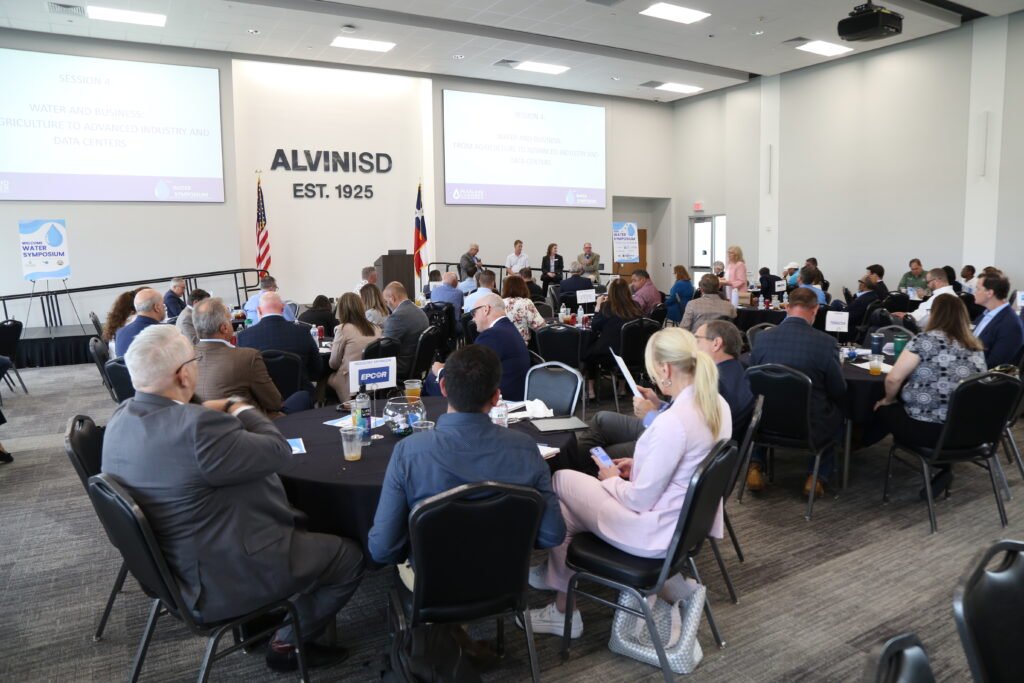
The symposium’s later sessions examined those regional systems in more detail, including the role of the Brazos River, Gulf Coast Water Authority, groundwater regulation, water reuse, desalination and legislative planning.
The bigger takeaway
Texas has spent more than a century debating where its water will come from and how far it should travel.
The old proposals may never have been built, but they reflect a problem that has not gone away: water is often abundant in one place and needed somewhere else. Moving it is possible. Paying for it, permitting it and finding agreement among the people who give it up and the people who need it are the harder tasks.
Mace’s presentation was ultimately a call for long-range thinking.
Texas may not need a pipeline from Canada. It may not need a canal from the Mississippi River. But it will need more than hope that current supplies remain sufficient under every future condition.
For communities across the state, the work is to understand their water risks now, build diverse portfolios and make decisions early enough that the next drought does not become a surprise.
About this article
This is written based on the keynote presentation, “Water in Texas: Who Fought for It, Who Moved It, and Why It Matters Today,” by Robert Mace, Ph.D., at the Pearland Chamber of Commerce Water Symposium, Aug. 27, 2026.
The 2026 Water Symposium did not offer a single solution to Texas’ water challenges. Instead, it brought together people working from different parts of the same system: legislators who fund and shape policy, city managers who plan for local growth, water authorities that move and treat supply, researchers who study ecosystems and resilience, farmers who depend on irrigation and industrial leaders who manage water at scale.
Pearland Stories published five articles examining each session from the 2026 Water Symposium in depth:
Texas water history, drought risk and the debate over moving water across long distances
Gulf Coast water supply, subsidence, surface water, reuse and conservation
Desalination lessons from Corpus Christi and what they could mean for Texas
Agriculture, industry, coastal resilience and data-center demand
The legislative issues expected to shape Texas water policy in 2027