
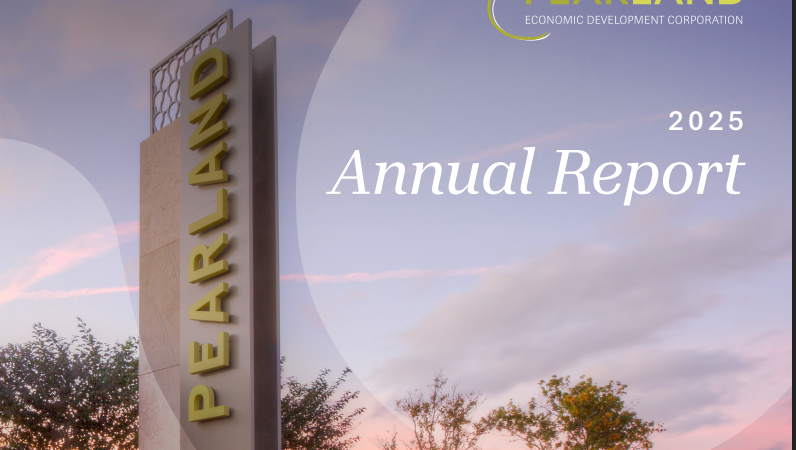
For the past several years, Pearland’s economic story has been about setting the table, adopting a long-range strategy, assembling partners, and preparing key districts for investment. The 2025 annual report from the Pearland Economic Development Corporation (PEDC) takes several steps forward. It reads less like a vision document and more like an operating report from a city that is now executing at scale. For local leaders, the message between the lines is clear: the groundwork from earlier years is paying off, and the next phase will test how well the city can manage growth while still feeling like the Pearland that is known and loved.
From Planning to Execution
At the heart of the report is a simple through line. PEDC is doing exactly what its mission says: creating a thriving, resilient economy and positioning Pearland as the community of choice for residents and businesses in the greater Houston region, but now with tangible projects you can drive past and point to. Guided by the 2024 Pearland Prosperity Economic Development Strategic Plan, the organization has moved from drafting strategies to implementing them across multiple corridors and industry sectors.
Lower Kirby is the best example of that pivot. Pearland’s largest speculative industrial development, once a big bet on future demand, is now 88 percent leased, welcoming Creative Innovation as the full cross dock tenant and Canopy Solutions in 82,560 square feet of space in the rear-load building. United Imaging, described as a global leader in advanced medical imaging technology, has committed to 216,000 square feet in the district and expects its workforce here to grow to as many as 185 employees over the next two years, reinforcing Lower Kirby’s role as a life sciences and advanced manufacturing hub. Stream Realty Partners is nearing completion on two class A flex buildings totaling 384,509 square feet, with completion expected in early 2026, aligning the area even more firmly with regional logistics and high value industrial users.
None of that happens without groundwork, and the report reminds readers that PEDC has been investing ahead of the curve. PEDC helped finance 1.6 million dollars in site development and infrastructure enhancements for the Levey Group project, and in 2025 it backed a major upgrade to Fruge Road, converting it from a two lane, asphalt, open ditch road into a concrete roadway with sidewalks, extended water lines, improved intersections and a new traffic signal. At the same time, the Lower Kirby Regional Detention System advanced with a Phase III expansion of the main pond to increase stormwater capacity in response to accelerating development across the district, a reminder that regional detention is as much an economic asset as a drainage solution.
Along State Highway 35, the same logic is on display. Edge Industrial Park, a 36 acre business park at SH 35 and McHard Road, is delivering more than 200,000 square feet of flex office, warehouse, and manufacturing space, backed by a PEDC funded development agreement that paid for new roads, drainage, water, and sewer as part of the SH 35 Redevelopment Plan. ERS CAT, originally recruited by PEDC in 2019, is now building a 10,000 square foot expansion and additional outdoor storage at its headquarters, extending an initial 4 million dollar investment in a 40,000 square foot facility and roughly 55 jobs. On top of that, PEDC is leading a 6.8 million dollar reconstruction of Industrial Drive and committing up to 7.4 million dollars to Knapp Road, projects explicitly tied to the State Highway 35 Redevelopment Strategy and the Site Development initiative in the Pearland Prosperity strategic plan.
For leaders who have watched the evolution of Pearland’s economic development work over the last five or so years, the contrast is telling. Earlier Pearland Prosperity communications focused on establishing those corridors as priorities and outlining the need for infrastructure and site readiness. The 2025 report documents that the city is now actively investing, landing tenants, and treating infrastructure as a catalyst, not an afterthought.
Old Town: Identity, Engagement, and the Next Chapter
If Lower Kirby and SH 35 are about jobs and investment, Old Town is where the report shows Pearland grappling with identity and sense of place. Old Town is described as the city’s original plat, the birthplace of Pearland’s identity and a district that continues to reflect its historic character and community spirit, with roots going back to 1894 and a mix of cultural landmarks and legacy businesses. In 2025, the City Council and the PEDC Board formally adopted the Old Town Revitalization Plan, elevating this area from nostalgic backdrop to a front-line economic and placemaking initiative.
The plan is a key initiative of the Pearland Prosperity plan and is explicit about balancing preservation and change. Its stated goal is to preserve Old Town’s character while encouraging thoughtful reinvestment and growth, and it does that by translating big ideas into physical concepts. The Depot District, anchored by the historic train depot, is envisioned as a civic and cultural hub for festivals and markets. The Grand Link is a continuous green corridor tying together parks, trails, and public spaces. Sender’s Square is a coordinated infill zone with new housing and small format commercial spaces. Broadway Street Realignment would turn a high speed thoroughfare into a pedestrian oriented Main Street. South Junction is focused on adaptive reuse, maker spaces, and pocket parks.
What stands out in this report, especially compared to earlier years when Old Town was more of an aspirational bullet point, is how much emphasis PEDC places on process. The plan was shaped not by a single directive, but through a year-long, collaborative process led by the city’s Community Development Department, with public engagement at its center. More than 2,880 residents took part in surveys, over 7,000 individuals engaged through pop ups, workshops, and virtual forums, and the plan reached more than 34,000 people overall. Community voices influenced priorities around walkability, public space activation, support for local businesses, and historic preservation.
For local officials and civic leaders, that is an important signal. This is not just a design centric plan being dropped on a historic district. It is a framework that will require ongoing political will, funding, and collaboration to implement. The report notes that PEDC is now actively working to implement these big Ideas in partnership with the City of Pearland and the community, which means the next several years will likely bring discussion around choices regarding streets, zoning, and public investment in Old Town.
Entrepreneurs, Talent, and the Human Side of Growth
Another evolution visible in the 2025 report is how fully the people side of economic development is integrated into the story. The Pearland Innovation Hub (PIH), funded by PEDC and managed by the Pearland Chamber of Commerce, continued to solidify its role as a cornerstone of Pearland’s entrepreneurial ecosystem in 2025. The renewed management agreement through September 2028 gives the Hub a stable runway, and the report notes that it comes with performance metrics tied to impact and accountability.
Programming has matured beyond one off events. In 2025, PIH hosted a Pitch Competition that brought ten local businesses to the stage. Yellow Apron Baking Co. took first place and 5,000 dollars in cash and business support services, with VS Midwifery Services and Financial Aid Frenzy also recognized. The annual State of Entrepreneurship gathered entrepreneurs, small business owners, and community leaders, with City Council Member and business owner Tony Carbone offering a keynote on the importance of mentorship and resilience. Monthly events like Morning Brew Connections, Entrepreneur Insights, and Funding Strategies are positioned as ongoing opportunities for learning and networking, and membership has grown to over 405 members with more than 356 hours of technical assistance delivered to local businesses.
WorkInPearland tells a parallel workforce story. The platform is described as a cornerstone of PEDC’s workforce development strategy, helping local employers find talent and keeping talent within the community. In 2025, more than 5,000 job seekers registered, exploring 300 job openings from 108 businesses and submitting over 3,200 applications, generating more than 19,000 booth interactions and multiple successful hires. The annual WorkInPearland Job Fair attracted 68 companies and 1,400 job seekers and resulted in 470 interviews, enough activity to earn coverage on ABC 13’s ‘Who’s Hiring’ segment.
Underneath those programs is a significant commitment to talent development. PEDC worked with employers to secure more than 2 million dollars in grant funding for employee training programs, enabling technical instruction, leadership development, and operational training at no cost to workers. The organization also partnered on a slate of career exploration events, including Pearland Next, Alvin ISD Career Extravaganza, the Jobs Y’all Career Exploration Fair, Career Signing Day where 40 local seniors signed job offers, the Engineer Your Future camp, and the Community Career Education Forum, to help students connect classroom skills to real jobs.
From a multi-year perspective, this is where the strategy is maturing. Earlier communications highlighted the need to build an entrepreneurial ecosystem and strengthen workforce pipelines as strategic goals. The 2025 report shows those ideas standing up as platforms with thousands of users, multi-year agreements, measurable outputs, and clear ties to the broader Pearland Prosperity framework.
Strategic Investment
Behind every project in the report is a ledger, and PEDC uses the final pages to show its financial capacity and how aggressively it now plans to deploy it. The mission statement reiterates that PEDC is committed to enhancing our community’s economic vitality through the attraction, retention and expansion of primary employers and that it supports those efforts by focusing on aesthetics, infrastructure, quality of life, image, workforce, and quality development and redevelopment of key Pearland districts and corridors.
In FY 2025, operating revenues totaled 18,091,822 dollars, driven largely by 15,888,222 dollars in sales tax and 1,772,698 dollars in interest income, alongside smaller intergovernmental and miscellaneous revenues. Expenditures came in at 10,575,380 dollars, leaving a positive net change in fund balance of 7,516,442 dollars and an ending fund balance of 47,040,588 dollars. For FY 2026, the amended budget projects 20,105,675 dollars in operating revenues but a significant ramp up in expenditures to 44,709,923 dollars.
Most of that jump is by design. Transfers to City are set to rise from 5,959,201 dollars in FY 2025 to 32,641,441 dollars in FY 2026, including 15.9 million dollars for Hickory Slough Sports Complex Phase II construction and 4.9 million dollars for Smith Ranch Road Sanitary Sewer Project Public Improvement District, among other infrastructure projects, alongside 5,430,000 dollars for capital outlay and infrastructure. The FY 2026 budget anticipates a negative net change in fund balance of 24,604,247 dollars and an ending fund balance of 22,436,341 dollars.
For policymakers, that is a pivotal shift. After several years of building reserves and funding planning work, the corporation is now signaling that it will spend down a substantial portion of its balance on large capital and quality of life projects. That is consistent with the Pearland Prosperity emphasis on places to gather, parks, mobility, and site development, but it will require vigilance to ensure those investments translate into sustained tax base growth, stronger employers, and broad community benefit.
Vision Moving Forward
Taken together, the 2025 annual report says this about Pearland’s direction. Lower Kirby and SH 35 are moving into a phase where infrastructure is mostly in place and the focus will increasingly be on tenant mix, value add projects, and ensuring supporting systems such as roads, detention, and utilities can keep up. Old Town is entering a design and implementation window that will test how the city manages tradeoffs between traffic flow, historic character, housing, and small business vibrancy. The Pearland Innovation Hub, WorkInPearland, and the manufacturing and training partnerships are poised to deepen their roles as connective tissue between employers, workers, and entrepreneurs, especially with multi-year commitments already in place.
For elected officials, business owners, and community leaders, the takeaway is that PEDC has left the strategy formation era behind. The question is no longer whether Pearland will grow, but how, and whether the projects now under way will make it easier for residents, employers, and visitors to experience Pearland as the community of choice for People and Business in the region that the Pearland Prosperity Plan envisions. As Chair Dena Hanks puts it in her letter, the organization is focused on implementing the Old Town Revitalization Plan, advancing infrastructure and workforce initiatives, and shaping a future of shared prosperity for Pearland, a future that is now coming into sharper focus on the ground, not just on paper.