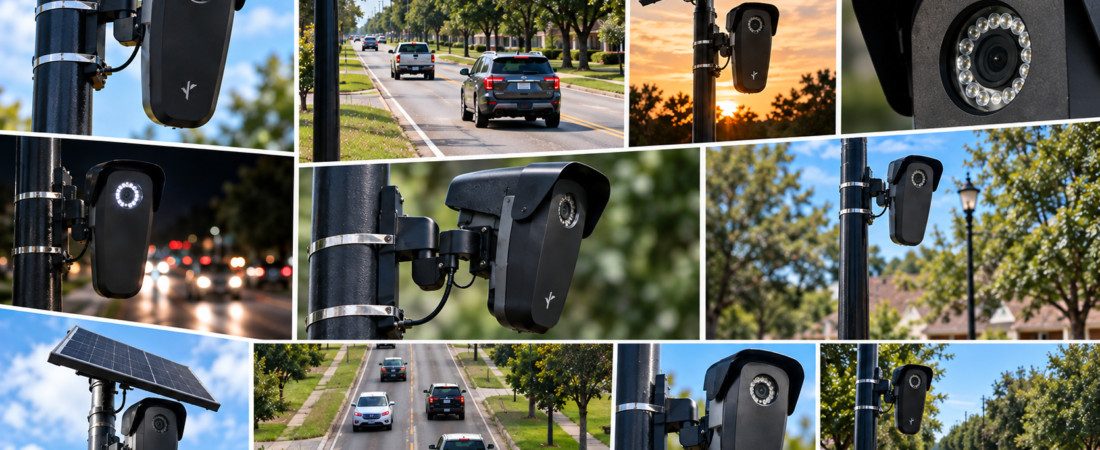
Public Information Officer Chad Rogers and Crime Analyst Lyndall Baker, both with the Pearland Police Department, sat down with Pearland Stories to discuss the misconceptions about the Flock cameras and how they are being used.
They said the department wants residents to understand both the system’s limits and the policies governing its use.
They emphasized that the cameras do not use facial recognition, record audio, issue tickets, measure speed, or identify the people inside a vehicle.
Rogers noted that the department’s use of Flock technology is focused on locating stolen vehicles, supporting criminal investigations, and helping find missing persons, not on tracking residents’ routine movements.
What Flock cameras do
Flock cameras are automated license plate reader cameras. Baker explained that when a vehicle passes a camera, the motion-activated system photographs the vehicle, reads its license plate and records the location and time associated with that camera.
The Flock software may also identify broad vehicle characteristics, such as make, model, color, vehicle type, and visible features like a roof rack, bike rack, bumper sticker, or window sticker. That information can help investigators narrow a search when they have surveillance video or a witness description but do not yet have a license plate.
He also added the camera system does not create a continuous, live GPS-style tracking record of a vehicle’s movements. A vehicle is only captured when it passes a participating camera. Officers cannot watch a car moving block by block through Pearland, nor does the system automatically tell police who is driving.
“There’s a lot of misinformation about how the system works, about us tracking folks, tracking every vehicle that comes into or out of the city,” Rogers said. “Most times, we are not interested in that vehicle until it becomes a potential suspect vehicle in a case.”
Baker noted that Pearland currently retains Flock data for 30 days and said the department has been thoughtful in discussing what’s appropriate when balancing the usefulness of the data vs. privacy concerns.
Pearland’s camera footprint
Pearland Police own 31 Flock cameras in the city. However, Rogers said residents should not assume every Flock camera in the city belongs to the police department. “The majority of Flock cameras, around 113 that residents may see, are privately owned by businesses, homeowners associations, and other private entities.”
Those private property owners choose to install the cameras to protect their own assets, deter theft and assist with investigations affecting their properties or neighborhoods.
How alerts are used
Baker said the department uses Flock most often through alerts linked to the National Crime Information Center, known as NCIC, as well as agency hot lists. Those alerts can include stolen vehicles, stolen license plates, missing persons and other vehicles connected to criminal justice concerns.
When a camera detects a matching license plate, an alert usually appears within 20 to 30 seconds. Officers and dispatchers can see an image of the vehicle, the plate, the camera location and the reason for the alert.
Baker also said that before acting on the alert, officers must verify that the plate shown in the Flock image matches the actual plate. They must also check NCIC to confirm that a vehicle is still listed as stolen or that another relevant alert remains active. The system can misread a character, such as confusing an X with a K or an 8 with a B, so visual and database verification are required.
Baker noted that an alert alone does not give officers automatic authority to stop a vehicle in every circumstance. If a vehicle is confirmed stolen through NCIC, that status can establish the basis for a stop. He said in other cases, such as an agency alert about a vehicle investigators want to locate, officers still must develop their own lawful basis, such as observing a traffic or equipment violation, before initiating a traffic stop.
The technology is intended to help officers locate a vehicle faster, but it does not replace police work or investigation.
“We don’t know who’s driving that vehicle,” Rogers said. “There’s still a tremendous amount of work that has to be done by officers because there is no AI technology that’s saying who’s driving it and we can’t just assume it’s the owner of the vehicle.”
Stolen vehicles and cases
Pearland Police officials said stolen-vehicle alerts have been one of the system’s most useful functions. Since the department began tracking Flock-generated results in mid-2022, more than half of stolen vehicles recovered by Pearland Police have originated with a Flock alert, according to Baker.
The department reported recovering 124 stolen vehicles with an estimated total value of about $2.3 million through Flock-related alerts since that time.
Police say quick recovery matters because stolen vehicles can be used in additional crimes, including vehicle burglaries, robberies and other offenses, before being abandoned, altered or dismantled. A stolen plate may also be placed on a stolen vehicle to conceal its identity.
In one recent case, Rogers said a man released from the Pearland jail on a minor charge allegedly stole a vehicle from a local gas station. The vehicle was located and the man was taken into custody in Houston within about two hours. Officers say rapid alerts can help agencies focus their resources in the area where a vehicle was recently photographed rather than searching broadly for a general description.
The department also cited a bank-jugging investigation in which an elderly man was robbed after leaving a financial institution and arriving at a local fitness center. Surveillance video showed only a distinctive suspect vehicle. Investigators used Flock searches to identify the vehicle and obtain a paper temporary-tag number, then placed the vehicle on a department hot list.
When the vehicle later returned to Pearland, officers stopped it and identified its occupants. The investigation ultimately led to the arrests of five people accused of robberies and burglaries connected to bank-jugging activity in the Pearland area.
Flock information has also helped police develop leads in burglary cases, robbery investigations and incidents involving stolen mail.
Since the program began, Pearland Police have made 407 arrests and filed 622 charges associated with Flock alerts, Baker said. The department also reported recovering or seizing 23 firearms and developing leads in about 370 incidents. Those figures include offenses ranging from misdemeanors to felony cases and warrants from other agencies.
Officials cautioned that a Flock lead does not necessarily solve a case. A vehicle may be linked to an offense, but investigators still must determine who was inside and whether the available evidence supports identifying and charging a suspect. Of the incidents in which Flock generated a lead, the department said 117 leads resulted in 174 individual warrants.
Missing-person cases
Flock alerts can also help police locate missing people when a vehicle associated with the person is entered into NCIC.
Baker described a recent case involving a 15-year-old runaway from Houston. The vehicle connected to the missing-person entry passed a Pearland camera around midday. Officers responded, located the vehicle at a local restaurant drive-through and found the teenager.
The department has also used the technology to identify when missing people may have traveled into other jurisdictions, allowing Pearland Police to notify the appropriate agency and help focus the search.
The process is similar to a stolen-vehicle alert: The system identifies a vehicle tied to a law enforcement entry, but officers must still respond, locate the vehicle and conduct an on-scene investigation.
Access is limited
Pearland Police say access to its Flock data is limited by user role, geographic scope and criminal justice purpose.
Within the department, officers and dispatchers who want to use Flock must first receive training from Baker, the department’s primary Flock administrator. The training covers department policy, how to handle alerts, verification requirements, lawful search practices and prohibited uses.
Each user receives an individual account. Access is removed or suspended when an employee leaves, changes assignments, is suspended or otherwise no longer needs access to the system.
Not every employee has the same access. Officers, detectives and dispatchers are assigned different roles based on their job responsibilities. Those roles limit the cameras and geographic areas users can search. For example, a patrol officer working in Pearland does not need broad access to cameras far outside the Houston region.
Before conducting a search, users are required to enter a case number or event number and select a criminal justice purpose. That requirement is intended to establish a documented link between the search and a legitimate law enforcement duty.
Pearland Police have shared access to their 31-camera network with in-state agencies only that have requested access. Those agencies can search Pearland’s cameras when working an investigation, such as when Houston Police Department investigators are looking for a vehicle believed to have entered Pearland.
The department has not placed its camera network into Flock’s statewide or nationwide reciprocal-sharing systems. In other words, Pearland’s cameras are not available for general searches by agencies across the country through those broader settings.
Baker said out-of-state agencies using Flock’s nationwide search tools may only receive a result from Pearland cameras when they are searching for a specific license plate and that plate actually passes a Pearland camera. Those agencies cannot open a Pearland camera feed or broadly search all vehicles captured by a Pearland camera during a selected time period.
Pearland Police does share access with specific federal agencies, including the FBI and U.S. Postal Inspection Service, according to Baker.
Audits and accountability
The department’s written policy is available through the Pearland Police Department’s online transparency page. Rogers said the policy details acceptable use, auditing requirements and the consequences for misuse.
Pearland Police conducts quarterly audits that examine three months of agency searches. Supervisors receive a randomized sample of searches to review. They check the employee’s name, the date and time of the search, the listed case or event number, the license plate or vehicle description searched and the user’s stated criminal justice purpose.
A search result may not always show a direct match within an offense report because investigators can review multiple potential vehicles while trying to identify a suspect vehicle. If a plate does not appear in a particular report, supervisors can ask the officer to explain the investigative basis for the search.
Flock also provides an audit-assistance tool that flags patterns for supervisory review. For example, the system may prompt an audit if a user searches for the same vehicle again after the department’s 30-day data-retention period or performs an unusually high number of searches for a single license plate.
Rogers said the department has found no misuse of Flock by Pearland Police employees through its audits to date. But he emphasized that improper use for a personal purpose, such as tracking a spouse, former spouse, girlfriend or boyfriend, would trigger an internal affairs investigation.
“Anything that was done that was not a criminal justice-related purpose would start the investigative process,” Rogers said.
Depending on the circumstances, an employee found to have misused the technology could be removed from duty while an investigation proceeds, disciplined for violating department policy, terminated or referred for criminal charges. The department would work with the district attorney’s office if the facts indicated a potential offense, Rogers said.
Officials said those safeguards are essential because misuse of technology damages public confidence in law enforcement.
“There’s a trust that is broken in our community,” Rogers said. “In the law enforcement profession, we have to have that trust from the people we serve because we’re dependent on that partnership.”
A tool, not a surveillance system
Pearland Police officials acknowledge that Flock technology is powerful and that residents have legitimate questions about privacy and oversight. Their position is that local policies, limited data retention, role-based access, required criminal justice justification, routine audits and meaningful discipline are intended to prevent the technology from becoming a system for monitoring ordinary residents.
They also stress what the technology does not do. It does not use facial recognition. It does not record conversations. It does not measure speed or issue traffic tickets. It does not provide continuous tracking. And it does not establish that the registered owner of a vehicle was necessarily the person driving it during an incident.
For Pearland Police, the department says, Flock is one investigative tool among many. It can help officers find a stolen car, narrow a suspect-vehicle search, recover a missing person or generate a lead in a serious case. It still requires officers to verify alerts, follow the law and conduct the investigative work needed to determine what actually happened.
You may view the policy and other department information on their use of Flock online at:
https://www.pearlandtx.gov/departments/police/foundational-elements
See the full interview on the Pearland Stories Podcast wherever you get your podcasts. Links available at: https://pearlandstories.com/podcast/
or on Youtube:
Pearland Police Explain Flock Camera Use, Privacy Safeguards and Accountability