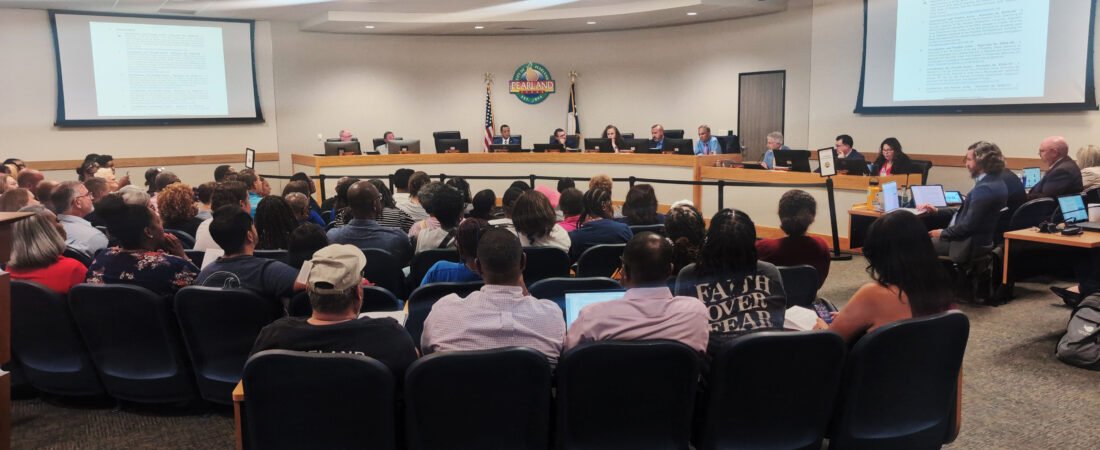
A lot of questions have arisen recently around Pearland City Council actions, decisions being made, and the roles and process behind them. Understanding the structure and form of Pearland’s government model adds missing context and explains the procedural side of that discussion. It also shows how consistency and stability are intended as built-in features and why rapid change is unlikely to happen through one or two elections.
When Pearland residents vote for mayor and city council, they are electing a governing body, not a single chief executive. Pearland operates under a council-manager form of government, which means City Council collectively sets policy, approves the budget, passes ordinances and hires the city manager, who oversees the city’s day-to-day operations.
That structure is different from Houston, where the mayor is the city’s executive leader with broad authority over the administration. In Pearland, the mayor is an important public leader, but not the person who independently runs city departments or directs city staff.
Pearland’s Council-Manager Model
Pearland’s City Council is the city’s legislative and governing body. It includes the mayor and seven councilmembers.
Together, they make the major decisions that shape the city, including:
• Approving the budget and tax rate
• Passing ordinances and setting city policy
• Approving major contracts, development agreements and capital projects
• Establishing priorities for infrastructure, public safety, parks, drainage, growth and other city services
• Hiring, evaluating and, if necessary, removing the city manager
The city manager is the council’s chief administrative employee. The manager oversees the city organization, administers the budget, carries out council policy and supervises the staff responsible for services such as police, fire, public works, planning, utilities, parks and finance.
In simple terms, City Council decides what Pearland will do. The city manager is responsible for making it happen.
That does not mean councilmembers should manage departments themselves. It means they are responsible for the results of city government because they choose the manager, establish the policies and approve the resources the manager uses to carry them out.
The City Manager’s Role
A city manager brings professional administration to local government. Rather than changing operational leadership with every election, the council hires a trained executive to manage the organization from day to day.
The city manager’s responsibilities typically include:
• Hiring and supervising department directors and city employees
• Preparing a proposed budget for council consideration
• Implementing council-approved policies and ordinances
• Managing contracts, projects and service delivery
• Advising councilmembers on legal, financial and operational implications of proposed action
• Maintaining continuity in city operations through elections and political transitions
The city manager serves at the direction of the full council, not the mayor alone. That is a central point in understanding Pearland government.
A mayor may have a strong relationship with the city manager, advocate for specific priorities and help communicate city goals. But the manager is accountable to the governing body as a whole.
The Mayor’s Role
The mayor is Pearland’s most visible elected official, but visibility is not the same as executive power.
In the council-manager form, the mayor presides over council meetings, represents the city at ceremonies and public events, helps communicate with residents and can provide leadership around the city’s priorities. The mayor is the ceremonial head of the city and an important voice in the public life of Pearland.
But the mayor does not independently manage city operations.
The mayor does not personally direct city departments, hire or fire department heads, set the city budget alone or instruct city employees to carry out a personal agenda. Those duties fall under the city manager’s administration, subject to the direction of the full City Council.
The mayor also does not function as a one-person City Council. Major decisions require council action, and meaningful initiatives require support from other elected officials. He votes only in the event of a tie, casting the deciding vote.
This is especially important as Pearland’s council procedures increasingly emphasize shared agenda-setting. If a mayor wants an issue formally considered, the mayor’s ability to build support with at least one fellow councilmember becomes part of the path forward. This reinforces the structure previous voters have chosen: Pearland is governed through a council, not by a single executive.
The Mayor’s Power is Collaboration
A successful Pearland mayor must be collaborative.
The office carries influence, public attention and a platform to elevate concerns. A mayor can listen to residents, identify emerging issues, encourage discussion and help build public confidence in city government. But influence becomes action only when the mayor can work with council colleagues to move an idea forward.
That means the most effective mayor is likely to:
• Build relationships with every councilmember, including those with different priorities or political views
• Bring resident concerns into constructive conversations before they become public conflict
• Seek common ground on issues such as growth, traffic, drainage, public safety and city services
• Work with the city manager and staff while respecting the council-manager chain of responsibility
• Use the mayor’s public platform to explain decisions and bring residents into the civic process
Collaboration does not mean the mayor should avoid difficult issues or abandon an independent point of view. A mayor can challenge assumptions, raise concerns and advocate forcefully for residents.
But in Pearland’s system, the mayor must turn advocacy into a coalition. A good idea does not become city policy because the mayor favors it. It becomes city policy when enough members of council agree to direct the city manager to act.
Why the Full Council Matters
Pearland’s government is designed to distribute authority across elected representatives rather than concentrate it in one person.
That can feel slower than an executive-led system. Councilmembers have to discuss issues, hear from residents, weigh staff recommendations and build a majority. But the structure also creates checks on any individual officeholder and ensures that large decisions reflect more than one person’s priorities.
The council’s responsibility is not passive. Councilmembers are accountable for selecting the city manager, evaluating that manager’s performance and determining whether the administration is carrying out the city’s goals effectively.
When residents have concerns about city operations, they should understand the chain of accountability:
1. City departments report through the city manager.
2. The city manager answers to City Council.
3. City Council, including the mayor, answers to Pearland voters.
That is why local elections for council seats matter so much. A councilmember may not be the public face of the city, but each member has a direct role in the decisions that guide Pearland’s growth, spending and services.
How Houston Differs
Houston offers the clearest local contrast.
Houston operates under a mayor-council system with a strong mayor. Its mayor is the city’s chief executive and has direct authority over the executive branch of city government. The mayor plays a central role in managing the administration, appointing department leadership, proposing budgets and setting the operational direction of the city.
Houston City Council still legislates, approves budgets and provides oversight. But Houston’s mayor has considerably more independent executive authority than Pearland’s mayor. In Pearland, residents should not expect the mayor to function like Houston’s mayor. The offices have the same title, but they operate in fundamentally different systems.
But each system answers a basic question differently: who has the authority to run the city?
In Houston, the answer is largely the mayor. In Pearland, the answer is the City Council acting collectively through the city manager.
What Residents Should Watch
For Pearland residents, understanding the structure helps clarify where to direct questions, concerns and expectations.
If the issue is an operational concern, such as service delivery, staffing, a project delay or a department decision, city staff and the city manager’s office are usually the appropriate starting point.
If the issue is policy, spending priorities, city direction or accountability for administrative performance, City Council is the decision-making body. Residents can contact any councilmember, speak during public-comment periods, follow agendas and meetings, and vote in municipal elections.
The mayor remains an important citywide leader, communicator and representative. But Pearland’s success depends less on a mayor acting alone and more on a mayor who can collaborate with councilmembers, work within the city’s governing structure and help turn shared priorities into action.
For Pearland, that is the system working as designed.
Additional Resources
The Pearland City Council posts all their meetings on the city calendar including links to their livestream at: https://www.pearlandtx.gov/residents/get-connected/city-calendar
https://pearlandtx.civicweb.net/Portal/MeetingInformation.aspx?Org=Cal&Id=13582
Video of previous meetings are posted to their YouTube page at:
https://www.youtube.com/@COPearland/streams
City of Pearland, City Council: https://www.pearlandtx.gov/government/city-council
City of Pearland, Council-Manager Form of Government: https://www.pearlandtx.gov/government/administration/council-manager-form-of-government
City of Pearland, “City Manager Role”: https://www.pearlandtx.gov/government/administration/city-manager-role
City of Pearland, Council Rules and Order of Business, August 2026: https://pearlandtx.civicweb.net/document/436598/p%20style=_text-align_justify;__strong%20style=_t.pdf?handle=D9681339BA0A4DB7A
National League of Cities, Forms of Local Government: https://www.nlc.org/resource/cities-101-forms-of-local-government/
Texas State Historical Association, Mayor-Council Form of City Government: https://www.tshaonline.org/handbook/entries/mayor-council-form-of-city-government
Texas State Historical Association, Commission Form of City Government: https://www.tshaonline.org/handbook/entries/commission-form-of-city-government
How Pearland’s City Government Works and Why Collaboration Matters