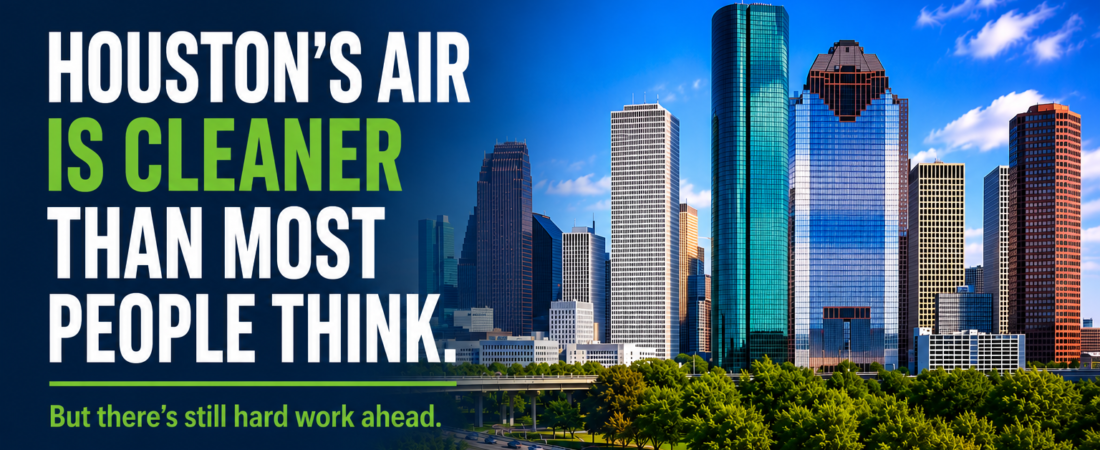
The air over Houston has a reputation problem, and the people who measure it for a living know it. Steve Smith, chairman of the Technical Advisory Committee for Houston Regional Monitoring (HRM), led a webinar on July 14 in partnership with East Harris County Manufacturers Association (EHCMA) to share what roughly 35 years of monitoring actually says about the air we breathe. The takeaway was not the doom many residents assume. It was more complicated than that, and in some ways more encouraging.
“Based on the feedback I get when I talk to community advisory committees,” Smith told the audience, “the biggest misconception is that people didn’t realize there had been this much improvement. They were of the impression that things are worse.”
A Region That Watches Itself Closely
The HRM monitors air quality around Harris County and the seven counties around it and is one of the most closely watched airsheds in the country. Smith noted that Houston runs the most extensive monitoring network in the nation, with 46 monitoring sites today compared with 19 back in 1999. Los Angeles, often held up as the benchmark for air trouble, has somewhere in the low to mid-20s.
“We know a whole lot more about what’s going on here,” Smith said.
He added that this matters because you cannot fix what you cannot see, and Houston sees a lot. The network measures ozone, nitrogen oxides, carbon monoxide, particulate matter, and a long list of volatile organic compounds.
The Ozone Story
Ozone is the pollutant Houston is best known for, and the one the region officially fails to meet. It is not pumped directly out of a smokestack. “Ozone is formed in the atmosphere when volatile organic compounds and nitrogen oxides mix in sunlight,” Smith explained.
This is why Houston’s worst ozone days cluster in August and September, and why almost none of it forms after the sun goes down.
Here is the encouraging part. Since 1988, the precursors that make ozone have dropped about 62 percent. A group of especially reactive chemicals produced along the ship channel, things like ethylene and propylene that go into plastics and synthetic rubber, have fallen to roughly three to four parts per billion. The number of days the region trips the ozone standard has declined sharply since 1999, even as the network of monitors watching for those trips has more than doubled.
The trend was not a straight line. Smith was candid that 2023 and 2024 were rough years, but he said things turned back around in 2025, and 2026 has started well. Several individual monitors, including ones at Lynchburg Ferry, Seabrook, and Lake Jackson, are now sitting below the current standard of 70 parts per billion.
Still, the region as a whole has not crossed into attainment. A handful of monitors, anchored by the Houston Aldine site, remain above it.
The Particulate Puzzle
Fine particulate matter, known as PM2.5, is a newer concern. These particles are tiny, small enough to slip past the nose and into the lungs, which is why federal regulators care about them.
In February 2024, the Environmental Protection Agency tightened the standard from 12 to 9 micrograms per cubic meter. That change pushed a number of Houston monitoring sites into territory that would be considered out of compliance, though the process has been tied up in court. A federal appeals court upheld the stricter standard in June 2026, and the region is now waiting to see how EPA responds and when the clock on compliance officially starts.
The data point to a familiar geography of risk. The highest readings cluster at Houston North Wayside, which sits beside a metal recycler, a concrete batch plant, and a rail yard, and at the North Loop, the required near-roadway monitor where diesel trucks are a constant presence. The lowest sit at Galveston’s 99th Street monitor.
That Galveston reading reveals one of the region’s thorniest problems. The natural background there, driven largely by sea salt, already sits around eight. The standard is nine. There is almost no room between what nature produces and what the rule allows.
“That’s part of the challenge,” Smith said. “How can we adequately control manmade sources to a point that we can get to just the natural sources?”
Why the Last Mile Is the Hardest
If the long-term trend is improvement, why does Houston keep falling short? Smith’s answer came down to arithmetic.
About a third of the nitrogen oxide inventory comes from cars and trucks, and the state cannot regulate vehicle emissions. That falls to the federal government. About a third of the volatile organic compounds come from trees and other natural sources, and nobody controls those. That leaves industry as the slice regulators can actually reach, and much of it is already controlled.
Smith pointed to modeling that the state ran a few years ago. Researchers simulated a future year with all industrial emissions shut to zero, leaving only natural and mobile sources. Even then, the region did not reach attainment.
He recalled a real-world version of that experiment. After a hurricane, when industry was down for two to four weeks, an ozone exceedance still popped up a few days later, possibly fed by the thousands of portable generators running across the area.
“It’s an interesting data point,” Smith said.
New complications are arriving. Some facilities are shifting toward hydrogen fuel to cut carbon dioxide, but hydrogen burns hotter, and hotter flames can generate more nitrogen oxides. Meanwhile, data centers and electric vehicles are stacking fresh demand onto the power grid. Each of those forces pulls against the others, and together they shape the question Smith keeps circling back to.
“Where do I make reductions?” he asked. “How do I make those reductions?”
What It Means for the Rest of Us
Smith is not a pessimist. He reminded the audience that 25 years ago people doubted Houston would ever meet the one-hour ozone standard, and it did. The same skepticism greeted the early eight-hour standard, and the region met that too. He expects the same will happen again, though it will take another round of regulatory change to push the numbers off their current plateau.
He also left room for personal responsibility. The daily choices people make, taking transit when the routes are there, retiring an aging car for a cleaner one, all add up across a region of millions. “We all play a role in meeting that challenge,” Smith concluded.
The Technical Advisory Committee (TAC) of the Houston Regional Monitoring Corporation (HRM) guides the most extensive, industry-funded ambient air monitoring network in the United States. Chaired by Steve Smith, the committee manages continuous air quality data in the Houston-Galveston-Brazoria area to inform public health strategies and industrial compliance. https://hrm.aecom.com/
The East Harris County Manufacturers Association’s mission (EHCMA) is to deliver value to members with health, safety, environmental responsibility, and economic growth in mind. Learn more at https://www.ehcma.org
Houston’s Air is Cleaner Than Most People Think. The Hard Part Is Still Ahead.