
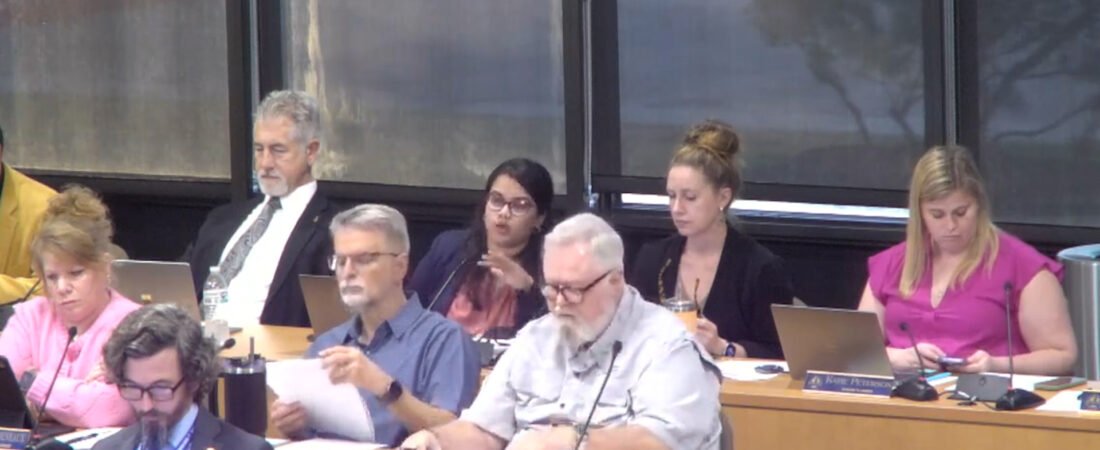
February 9 City Council / Planning & Zoning Special Meeting
Pearland City Council and Planning & Zoning commissioners spent most of their February 9 joint workshop wrestling with how Pearland should grow – from rewriting the city’s development rules to weighing a controversial light industrial project on Main Street.
UDC rewrite: simpler structure, more housing tools
Consultants and city staff walked officials back through the “50% draft” of Pearland’s Unified Development Code (UDC) update, calling this meeting a continuation of December’s Workshop #4 and a chance to regroup after a website glitch slowed public access to the draft. The goal is to move from this mid stage draft to a “90% draft” and position the code for adoption in late spring or early summer.
Key structural changes include:
Putting all procedures (zoning, subdivisions, variances, public hearings) into one chapter with charts and tables that spell out who does what, when notices are required, and where authority lies.
Adding process diagrams for major applications and reorganizing definitions by topic instead of alphabetically to make the code easier to use for applicants, staff, and decision makers.
Zoning districts: consolidation and infill debates
A major focus was consolidation of the city’s zoning districts. Staff said they evaluated each district with three questions: does it create a different development pattern, allow meaningfully different uses or building forms, and support the future land use map. Districts that failed those tests are being merged. The result is a streamlined set of residential, commercial, mixed use, and industrial districts intended to be easier to understand and administer, without triggering automatic rezonings.
On the residential side, many legacy single family districts with similar standards are rolled into broader categories such as:
- R 1 “low density residential,” combining older large lot suburban districts.
- R 2 “general residential,” a typical suburban fabric that supports infill and minor redevelopment.
- MDR “medium density residential,” intended to expand “missing middle” housing with shared open space and more pedestrian oriented design.
- MHR “medium high density” and HDR “high density residential,” which bridge townhomes and multifamily and support 2 to 3 story apartments and corridor infill.
Some commissioners and council members pushed back, arguing that “low density” labeling does not match residents’ perception when actual lot sizes shrink and net units per acre rise. Several stressed that most public outcry comes with higher density projects, particularly apartments, and warned that rebranding tighter subdivisions as “low density” could be seen as misleading.
A planning commissioner again raised a long standing complaint about older neighborhoods where individual homes are being torn down and rebuilt under today’s drainage rules. He argued the current code treats infill rebuilds as if they were new subdivisions, forcing rear to front drainage patterns that conflict with original designs and cause runoff onto neighbors. Consultants acknowledged the issue, said they remembered a December case that illustrated the problem, and indicated changes will have to appear not only in the UDC but also in the city’s criteria manual.
Townhome and small lot products drew special attention. One council member said he hoped the UDC rewrite would actively support the kind of detached, high quality small lot homes being built by Sullivan Brothers in Old Town, rather than making that product harder. Staff noted the 90% draft will further adjust townhome standards, including bringing minimum lot sizes down (with a target around 2,250–3,000 square feet for some formats) to better fit compact housing.
Planned developments: “light” vs “heavy” and public notice
The code team is also restructuring how planned developments (PDs) work, introducing a two tier system.
A Tier 1 “PD light” is aimed at smaller, single use or infill projects with minimal deviations from base zoning, offering a streamlined path for cases that generally meet community expectations.
A Tier 2 PD is reserved for larger or more complex proposals, such as mixed use or incentive heavy projects, and is intended to get more detailed review and additional notice.
Planning and Zoning commissioners emphasized they want to remain part of PD review, especially for Tier 2 projects, so that council receives “cleaner” cases and does not have to shoulder the entire zoning workload. Council members agreed Tier 2 PDs should come with stronger engagement and expressed interest in formally requiring more Planning and Zoning involvement and earlier notice for higher impact projects.
That discussion quickly shifted into a broader debate on public notification. Under state law, cities must notify property owners within 200 feet of a proposed zoning change. Several council members said that minimum is not capturing the neighborhoods that actually show up angry at second reading, and one council member noted he has heard repeatedly from residents who never received letters despite being affected.
Ideas floated included:
Sending mailed notices before joint workshops, not just before formal public hearings, so neighbors can weigh in earlier in the process.
Potentially sending two rounds of notices on major PDs: one early for the workshop, another before the Planning and Zoning hearing and council vote.
Increasing the city’s standard radius beyond 200 feet, possibly to 500 feet, while still complying with the state minimum. Council asked staff to bring back examples of what 200 versus 500 foot notice areas look like in recent cases and to estimate mailing cost impacts for applicants.
Some members argued the city should “stay within the law” and avoid arbitrary radii that invite questions about why specific homes were included or excluded, while others said 200 feet clearly misses neighbors who feel the impact and that staff should consider larger, but consistently applied, radii. There was also discussion about leveraging HOA boards, who already receive notice when they own adjacent common areas, to help disseminate information more widely within subdivisions.
ADUs, mixed use and triggers
Accessory dwelling units (ADUs) also came up. The draft code explicitly defines an ADU as one habitable structure with full facilities per lot and would require each ADU to secure a conditional use permit, allowing case by case review. Staff said one motivation is to guard against potential state legislation that could allow multiple ADUs per lot, which Pearland would like to avoid by codifying a “one ADU” limit. At least one council member expressed concern that family based occupancy conditions are effectively unenforceable and warned that ADUs risk turning single family lots into de facto multifamily if not tightly controlled.
On the non residential side, the team described simplifying commercial and mixed use districts by merging overlapping categories and more clearly distinguishing neighborhood scale centers, regional/corridor commercial, horizontal mixed use centers, and vertical mixed use districts that allow residential or office above ground floor retail. The former “spectrum” industrial district is being reorganized into clearer buckets such as entertainment focused uses, research and development, and higher quality industrial.
The land use matrix, one of the most heavily used parts of the UDC, has been reorganized around American Planning Association land based classifications, with grouped categories, cleaner definitions, and a deliberate reduction in conditional use permits where impacts are predictable. Council requested a specific list of uses that would newly be allowed “by right” under the proposed matrix, signaling concern about unintended expansions of industrial and commercial activities in sensitive areas.
Finally, staff noted that “triggers” tables, those thresholds where remodels or expansions suddenly require full site upgrades, are being revised, and promised to circulate the proposed changes.
Incentives for public space, trees, and stormwater
To complement stricter baseline standards, the draft UDC introduces a menu of voluntary development incentives. These would offer limited flexibility in setbacks, parking, or lot coverage in exchange for specific public facing improvements.
Examples discussed included:
- Allowing up to a 25% reduction in front setbacks if a commercial project installs 100% drought tolerant landscaping selected from an approved list, improving water efficiency and long term maintenance.
- Allowing up to a 10% increase in lot coverage where a developer provides roughly 1,200 cubic feet of soil volume per tree to promote long lived canopies and better stormwater absorption.
- Incentives tied to trail connections, enhanced open spaces, and higher quality, “activated” street frontages.
- Officials generally welcomed the idea of “narrow, predictable” incentives that let projects go above baseline while delivering tangible community benefits, but they stressed that flexibility must not undercut basic protections on drainage, compatibility, and neighborhood character.
- Second workshop: Light industrial proposal returns on Knapp and Main
In the second half of the joint meeting, council and commissioners revisited a previously rejected proposal: a roughly 173,100 square foot light industrial distribution building on about 13.5 acres south of Knapp Road and east of Main Street. The site is currently zoned General Commercial, sits within a manufacturing future land use designation, and is bordered by other industrial zoning to the south.
The same applicant had sought a straight M 1 rezoning earlier this winter, but council unanimously voted 0–6 against that request, citing concerns about the breadth of M 1 uses in this location. At that time, council suggested the development could move forward under either a conditional use permit or a “light” planned development that would narrow the allowed uses. In response, the applicant returned with a PD request using M 1 as the base district but layering on specific use restrictions modeled heavily on the recently approved Hanover PD to the north.
Project details and deviations
According to staff’s summary and the applicant’s presentation, the proposal includes:
A single 173,100 square foot, front load distribution building with about 112 parking spaces, two drive in doors, and 38 dock doors.
Primary access on Main Street and secondary access via Knapp Road, with internal circulation designed to keep most trucks inside the site and avoid queuing on public streets.
On site detention designed to handle both the new development and existing runoff from the adjacent Pearland Alternator property, which the developer is purchasing from owner Al D. Coker; the combined system would discharge to Hickory Slough.
The applicant asked for several deviations from current standards, including increased maximum height, adjustments to landscape requirements and parking lot island plantings, screening and fencing variations, and modified façade articulation along the Main Street corridor overlay. They argued the added height is needed to accommodate a 32 foot clear interior warehouse with roof structure and modest parapet treatments that break up the front façade, while actual wall heights would mostly remain in the 40 to 45 foot range.
Initially, the PD submittal also asked that dry detention areas count toward the required 15% landscape area, which drew caution from at least one Planning and Zoning commissioner worried about setting a precedent citywide.
Use restrictions and traffic concerns
To respond to earlier council objections to a full M 1 rezoning, the applicant submitted a long list of prohibited uses, mirroring Hanover’s PD, to rule out more intense industrial activities such as concrete batch plants and other heavy operations that would be inappropriate at this gateway location. At the same time, they asked to preserve flexibility for typical “light” tenants: distribution, very light manufacturing, and even some less traditional users like indoor recreation or showrooms, noting they have seen indoor trampoline parks and similar concepts lease industrial space in other projects.
Council and commissioners largely welcomed the narrower use list but zeroed in on traffic circulation. The property’s Main Street frontage currently only has a southbound to east “hooded left” that feeds into nearby businesses, and TxDOT has reportedly told the developer it will not open the raised median for a new full movement entrance. That means trucks coming from the Beltway and heading south cannot directly turn into the site; instead, they would need to:
Exit earlier at Knapp Road and approach from the east, or
Continue south, use a distant turnaround route that staff and elected officials described as cumbersome and ill suited for heavy truck traffic.
Several members pointed out that, in practical terms, Knapp Road becomes the primary access for a large share of trucks, especially those coming from the north. Knapp Road is in line for reconstruction to a two lane section with curb, gutter, sidewalks, lighting, and storm sewers, similar to recent projects on Hallik and Rice Drier, with an estimated 18 month buildout. Even with that upgrade, council members noted:
The eastern connections involve older segments and nearby streets like Old Alvin that are not built as truck routes and pass near established neighborhoods.
Residents along Knapp and in adjacent subdivisions are already concerned about truck traffic from other developments, including Hanover.
The applicant’s traffic narrative estimated about 19 truck trips and 35 car trips per day, with tenants operating mostly on daytime business hours and not as a 24 hour hub. They said the internal driveway on Knapp is intentionally long to allow queuing on private property and avoid trucks stacking onto the roadway. However, at least one council member noted that even a short term cluster of trucks can spark complaints, citing a recent instance where several 18 wheelers staged on a property and prompted questions about whether a truck sales operation was underway.
Design, fencing, and next steps
Visually, the building would resemble other modern tilt wall industrial projects on Main, including Hanover’s, with articulated panels and glass along the Main Street frontage to meet overlay expectations. One council member praised the look as “much prettier than the flea market down the road” but worried that a growing string of nearly identical boxes risks giving the corridor a monotonous feel.
Fencing emerged as another friction point. The applicant said many of their tenants request full site fencing for security and initially proposed chain link with slats. Staff responded that the corridor overlay does not allow chain link along Main, and council signaled they would expect upgraded materials, such as masonry or high quality metal systems, especially on street facing edges.
City staff confirmed there is no mapped floodplain on the building site itself but noted that Hickory Slough is a designated floodway and development must stay out of that area and meet all mitigation requirements. The PD language includes a statement that floodplain areas should not be encroached upon without “stringent” management practices, which one council member flagged as too vague; staff replied that any future development would still be required to meet formal drainage criteria and floodplain rules.
By the end of the discussion, council members offered guarded encouragement to the development team. Multiple speakers thanked the applicant for returning with a PD instead of a blanket M 1 rezoning and for copying much of the Hanover use limitation framework. At the same time, they stressed that the project faces “a tall mountain to climb,” particularly on truck routing, roadway capacity, and interface with nearby neighborhoods. Staff took notes on council’s direction and will work with the applicant on refined access, height language focused on parapets rather than full building walls, fencing upgrades, and clarification of deviations before any formal PD ordinance moves forward.
The joint workshop adjourned after the second discussion, with officials set to revisit both the UDC rewrite and the Knapp/Main industrial PD at future meetings.
Livestream of the meeting online at: https://www.youtube.com/watch?v=5VJ5MV2Kg9E
Agenda:
CITY COUNCIL AND PLANNING AND ZONING COMMISSION
JOINT PLANNED DEVELOPMENT WORKSHOP
AGENDA
MONDAY, FEBRUARY 9, 2026 4:30 PM
PEARLAND CITY HALL |COUNCIL CHAMBERS│3519 LIBERTY DRIVE
I. CALL TO ORDER
II. ROLL CALL AND CERTIFICATION OF QUORUM – CITY COUNCIL
III. ROLL CALL AND CERTIFICATION OF QUORUM – PLANNING AND ZONING COMMISSION
IV. CITIZEN COMMENTS
V. REGULAR AGENDA
1. Discussion: Regarding the Unified Development Code (UDC) Update.
UDC Update Workshop #5 AIR-26-035 – Pdf
2. Discussion: A request by Thomas Forschner, applicant, on behalf of Pearland Storage LLC. and Al D Coker, owners, for a Planned Development Workshop as required by the Unified Development Code, regarding a proposed light industrial development on 13.147 acres of land, to wit:
Legal Description: Tract 1: A 10.594-acre (461,461 square foot) tract of land situated in the HT & B RR CO Survey, A-542, Brazoria County, Texas. Said 10.594-acre tract being out of the residue of Tract “A” of Ray Bellew & Sons Subdivision, by plat recorded in Volume 17, Pages 21 & 22 of the Brazoria County Map Records, (hereinafter B.C.M.R.), being all of a called 10.61-acre tract of land conveyed to Pearland Storage LLC, by deed recorded under Brazoria County Clerk’s File Number 2022040143 (hereinafter B.C.C.F. No.) of the Official Public Records of Brazoria County, Texas (hereinafter O.P.R.B.C.). Tract 2: Being a description of a 2.553-acre (111,198 square foot) tract of land situated in the HT & B RR CO Survey, A-542, Brazoria County, Texas. Said 2.553-acre tract being all of a called 2.2550-acre tract of land conveyed to Al D. Coker and wife, Barbara A. Coker, by deed recorded under Brazoria County Clerk’s File Number 1998043460 (hereinafter B.C.C.F. No.) of the Official Public Records of Brazoria County, Texas (hereinafter O.P.R.B.C.),
General Location: South of Knapp Road, East of Main Street, Pearland, Texas.
ZON2026-0031 Joint Workshop Request AIR-26-030 – Pdf
VI. ADJOURNMENT