
Pearland Stories
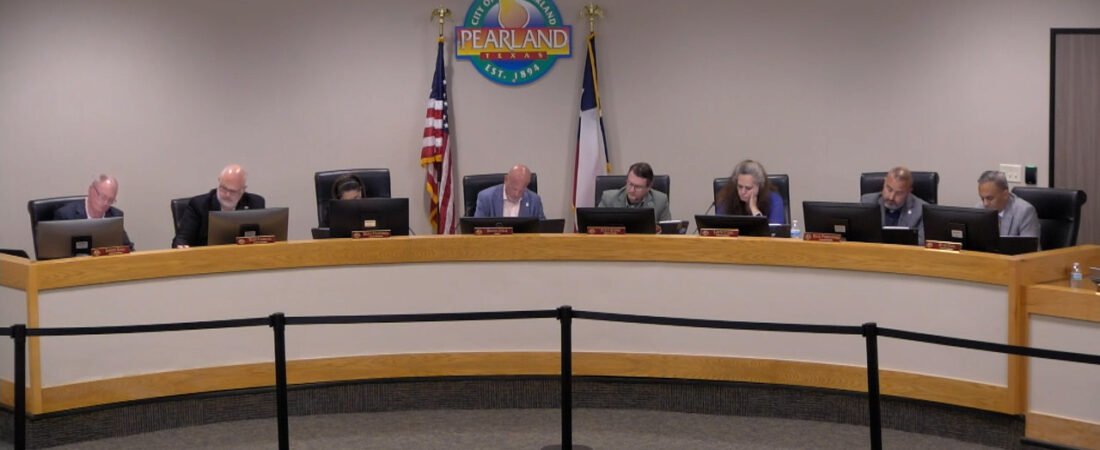
The Pearland City Council’s February 23 regular meeting moved briskly through a full agenda that ranged from neighborhood land use debates to approvals for new economic development and mobility projects across the city.
No citizen comments, traffic signal upgrade approved
After the invocation, pledges and roll call, City Secretary Frances Aguilar certified that all councilmembers were present and no citizen comment cards had been submitted.
Council pulled a single item from the consent agenda for open discussion: Resolution R2026-43, authorizing the purchase of a NoTraffic vehicle detection system for 11 signalized intersections. Staff explained that the project replaces outdated vehicle detection equipment and continues a methodical upgrade of the city’s traffic signal network using a cooperative “BuyBoard” purchasing contract.
The standard co-op price of about 355,000 dollars was negotiated down to approximately 319,100 dollars, which staff and the vendor described as a volume discount tied to the number of intersections included. Councilmembers questioned how often Pearland has been able to negotiate below BuyBoard pricing and asked staff to make that type of negotiation part of the city’s standard practice going forward.
Engineering staff noted that many of the chosen intersections have failing or failed detection systems and that grouping them also supports future signal coordination along key corridors. While the NoTraffic hardware will be in place, staff added that the artificial intelligence integration for adaptive timing will require separate funding and at least five to six linked signals before a corridor pilot can move forward. Council unanimously approved the resolution on a 7–0 vote.
Debate over backyard accessory dwelling in Green Tee
The most extensive discussion of the night centered on a Conditional Use Permit (CUP) request to allow an accessory dwelling unit (ADU) behind a single-family home at 2301 Dublin Circle in Green Tee Terrace. The applicant proposed renovating and expanding an existing rear garage into a 1,212-square-foot structure, including a 665-square-foot one-bedroom unit for an aging parent.
Planning staff reported that the surrounding zoning is entirely R-1 single-family, the land use plan designates the area as traditional residential, and the proposal meets city size and impervious-cover limits for accessory structures. The Planning and Zoning Commission (P&Z) had recommended approval on a 4–2 vote with a condition that the ADU could only be occupied by someone related to the primary homeowner by first or second degree of consanguinity or affinity.
No neighbors spoke for or against the request, and no written protests were received despite notification to property owners within 200 feet. However, several councilmembers voiced strong concern about long-term enforcement and the precedent for adding de facto multi-family capacity into established single-family neighborhoods.
Council and the city attorney spent considerable time walking through enforcement scenarios:
The existing “related occupant” condition is legally recognized language but would rely on nontraditional enforcement, such as checking marriage records or even “blood tests,” which staff and council agreed is not realistic for routine code enforcement.
Councilmembers worried about what happens when the property changes hands and a future owner quietly rents the unit long-term or uses it as a short-term rental.
The attorney noted that while the city could theoretically revoke a CUP and, in an extreme case, seek removal of a stove or even structures through a Chapter 54 court action, those remedies are difficult and uncommon.
The homeowner, David Deriso, told council he has lived at the property for about five years and wants to give his mother, who lives in a nearby apartment on Social Security, a dignified place to live near her grandchildren. He emphasized that he intends to stay in the home long term, has no intention of creating a rental unit and would accept restrictions against renting if necessary.
Staff also confirmed a key technical point: if the plan were revised to remove the dedicated stove and associated gas or 220-volt connection so that a full kitchen could not be installed, the space would no longer meet the city’s definition of a dwelling unit and could be built “by right” without a CUP. The applicant, however, said he wanted his mother to be able to cook independently and preferred to pursue the full ADU.
In an effort to balance property rights with neighborhood protections, council took two amendment votes on the resolution:
First, they added a condition explicitly prohibiting rental of the accessory dwelling unit, to create a clearer and more enforceable standard than the relationship requirement alone. That amendment passed 6–1.
Second, they formally added staff’s original “related occupant” condition to the CUP, also on a 6–1 vote.
Despite those safeguards, the final vote on the fully amended CUP failed 3–4, denying the request. Councilmembers cited ongoing concerns about enforceability, neighborhood precedent and the risk that future owners could convert the space to rental use despite the conditions.
High-performance auto shop approved in Old Town business district
Council took a different approach to a CUP request for an auto repair (minor) use at 2418 Main Street in the Old Town–General Business (OT-GB) District. The applicant, operating under the name Modern Speed Works, plans to use an existing building as a specialized performance electronics and calibration shop.
Staff reported that public notice generated one written protest citing concerns about potential noise impacts on nearby residential areas and a family-friendly restaurant to the north. A staff map showed numerous existing auto repair uses within one, two and three miles, underscoring the automotive character of the broader area.
At the podium, the business owner described the operation as low-volume and appointment-only, focusing on installing and tuning modern engine control systems in both newer vehicles and classic cars receiving contemporary drivetrains. She explained that most work is performed indoors, that vehicles are not stored outside, and that jobs often last from several weeks to months, which limits traffic and turnover.
Council asked about the presence of a dynamometer and potential noise. The applicant acknowledged they have a dyno but said it can be operated with doors closed and ventilation fans running, such that it is not noticeably louder than ambient noise outside. Council also confirmed that the building had been vacant for several years, previously used by the owner’s pest control business.
Finding the use compatible with the OT-GB district and satisfied with the applicant’s description of indoor operations and noise controls, council unanimously approved Resolution R2026-CUP2025-0574 on a 7–0 vote.
Goodwill consignment store proposal on 288 corridor rejected
Council was less supportive of a proposed 15,000-square-foot Goodwill resale and consignment store on a 2.438-acre tract east of Business Center Drive, between Broadway and Magnolia Parkway in the BP-288 Business Park District.
Planning staff recommended approval with conditions addressing landscaping, outdoor storage and building transparency along Business Center Drive:
End-cap parking islands must include evergreen trees at least three inches in caliper.
Storage, display or staging of goods and donations outside the principal building would be prohibited, with any dropped items required to be moved indoors or into a dumpster immediately.
At least 25 percent of the west façade facing Business Center Drive must be transparent.
The applicant’s architect said the initial design provided only about 7 percent transparency on that facade, which Goodwill considers appropriate for its internal layout and security. As a compromise, he presented a revised elevation that increased storefront height and added transom windows, raising transparency to roughly 14 percent.
Councilmembers questioned both the reduced glass and the mass of solid masonry facing a major commercial corridor where the city has invested heavily in aesthetics, including approximately 20 million dollars in corridor improvements and about 3 million dollars in signature piers. Several councilmembers argued that accepting significantly less than the 25 percent transparency standard on a ground-up new build would undermine adopted corridor design policies and send the wrong signal to future developers.
There were no public speakers on the item, and no written protests were reported. Even so, when the motion to approve the CUP with staff’s three conditions came to a vote, council rejected it 0–7, effectively denying the Goodwill proposal at that location.
Major mobility and maintenance contracts move forward
In its new business section, council approved several significant infrastructure items.
Kingsley Clear Creek Bridge expansion design: Council adopted Resolution R2026-45, authorizing a professional services contract with LJA Engineering for an estimated 726,428.18 dollars to design the Kingsley Clear Creek Bridge expansion. The item also authorizes the City Manager to enter into a reimbursement agreement with the Pearland Economic Development Corporation (PEDC), which is partnering on funding for the project. PEDC’s board has already endorsed the engineering contract.
Citywide asphalt repair contract: Through Resolution R2026-5, council awarded a unit-price asphalt repair contract to Forde Construction Company, Inc., not to exceed the annually budgeted amount. Forde is the contractor currently handling asphalt paving in the Wesley subdivision, and the new contract covers a next group of street sections selected based on the citywide Pavement Condition Index (PCI) study. Staff noted that the largest portion of funding comes from capital dollars allocated for asphalt repair and restoration in FY25 and carried into FY26, with an estimated 985,000 dollars in work planned under this award.
During discussion, staff pointed residents to the city’s public GIS dashboards, accessible via the city website’s maps section, where they can view current street projects and condition ratings. Council also asked staff to evaluate new pavement preservation technologies highlighted by one member, including injection and coating methods used in cities like Irving, Texas, and to report back on where they might fit in Pearland’s network.
Eminent domain resolutions for Lower Kirby infrastructure
Council unanimously approved four resolutions authorizing the use of eminent domain for targeted acquisitions in the city’s Lower Kirby area to support new roadway, drainage, water and sewer improvements. In each case, the city has obtained appraisals, made initial offers, provided the state-required landowner Bill of Rights and attempted to negotiate purchases; in some cases, owners have not responded, and in others, counteroffers have far exceeded appraised value.
Highlights from the four parcels include:
Parcel 10 – William D. Berrios (R2026-46): Acquisition of a 0.4168-acre fee interest for public road right-of-way and a 0.0815-acre easement for water and sanitary sewer improvements in the Richard T. Blackburn Survey. Staff noted one appraisal valued a similar tract at about 181,736 dollars, compared with a 2 million-dollar landowner counteroffer.
Parcel 1 – GTP Acquisitions II, LLC (R2026-49): Acquisition of a 0.0892-acre fee interest for road right-of-way, a 0.4895-acre fee interest for drainage improvements and a 0.0446-acre utility easement in the James Hamilton Survey. The city’s appraised offer was just over 100,000 dollars, with no counteroffer received.
Parcel 4 – Harris County (R2026-48): Acquisition of a 0.0382-acre fee interest for right-of-way, a 0.0332-acre fee interest for drainage and a 0.0414-acre utility easement on a 2.6-acre tract owned by Harris County in the James Hamilton Survey.
Parcel 9 – Berrios Mechanical, LLC (R2026-47): Acquisition of a 0.3794-acre fee interest for road right-of-way and a 0.0759-acre utility easement, also in the Richard T. Blackburn Survey.
Staff emphasized that moving into the eminent domain process is necessary to keep Lower Kirby roadway and utility projects on schedule, particularly in Harris County where the condemnation timeline is longer. The city can still negotiate and settle with property owners before hearings, but the resolutions allow the City Attorney to proceed to special commissioners if needed, with appraised values forming the basis of the city’s position.
All four eminent domain resolutions passed 7–0.
Executive session actions on land and economic development
In executive session, council met under Texas Government Code Sections 551.072 and 551.087 to discuss real estate transactions and economic development negotiations. After reconvening in open session at 8:17 p.m., members took three related actions:
- Authorized the City Manager or his designee to enter into a development agreement with “Prospect 2403” and a reimbursement agreement between the city and PEDC. One councilmember recused due to a conflict, and the motion passed 6–0.
- Authorized staff to move forward with land acquisition for Project 2601, consistent with executive session discussion. That motion passed 7–0.
- Authorized the City Manager to execute an amendment to the development agreement for Project 2300, also tied to economic development negotiations, on a 7–0 vote.
Council adjourned the meeting at 8:20 p.m.
See the livestream of the video at: https://www.youtube.com/watch?v=_1_B3RphkFU
Meeting Agenda posted to the City of Pearland Website:
https://pearlandtx.civicweb.net/Portal/MeetingInformation.aspx?Org=Cal&Id=13444