By Brant Mills, Pearland Stories
The Independence Park Project is Pearland’s next big step toward bringing everyone together with their focus on intentionally designed, inclusive shared spaces. This is more than a park upgrade. It is a commitment to creating a space where kids, parents, grandparents, neighbors, and visitors of all abilities can play, connect, and build memories together in the heart of the city.
At the core of this project is a capital campaign led by the Forever Parks Foundation of Pearland in partnership with the City of Pearland. Together, they are working to transform Independence Park into a four-acre all-inclusive play space and regional water play destination shaped by the principles of universal design. Their goal is to create a park experience where accessibility is not an add-on, but the standard.
To achieve this, the campaign seeks to raise $5 million in private and philanthropic support to complement the City’s 2023 voter-approved Phase II bond funding. The bond currently allocates $700,000 to inclusive play, which is a meaningful start but not enough to deliver the full vision. The campaign’s purpose is to close the gap between what is funded and what is possible so that a truly comprehensive universal design concept can come to life.
Phase II improvements are designed to touch nearly every part of the park experience. The existing pond will be expanded and reshaped into a 5.6-acre naturalized amenity lake where visitors can enjoy kayaking, paddleboarding, and fishing. Surrounding this lake, improved lighting, expanded parking, and stronger trail connectivity will make the park easier, safer, and more welcoming to navigate. Sports facilities will be consolidated into a dedicated complex so activities such as tennis, pickleball, sand volleyball, and field sports are easier to access and enjoy.
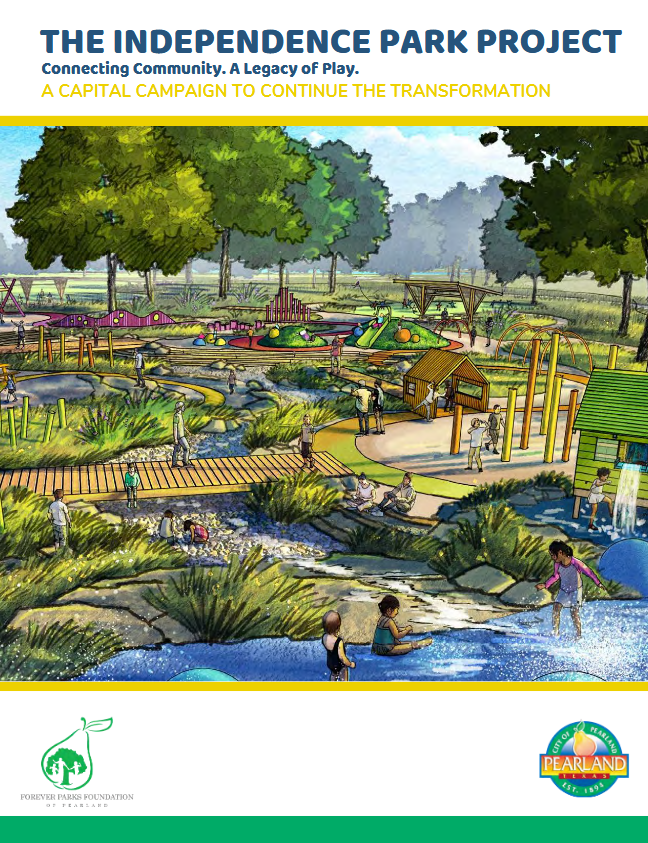
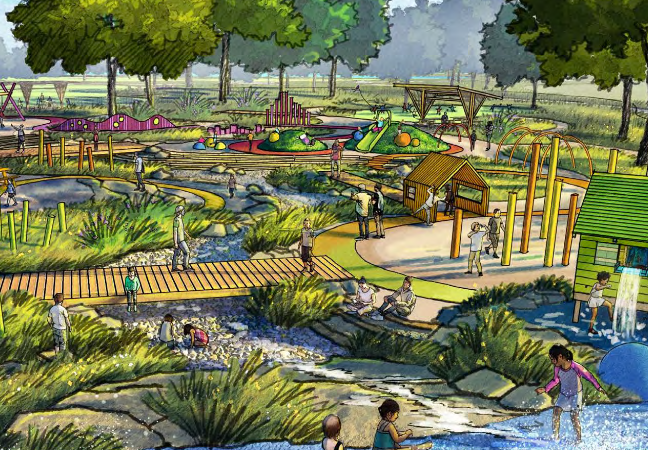
Central to the design is an all-inclusive play space and splash pad, bringing the vision of barrier-free, multi-sensory, intergenerational play to life. The design organizes play into distinct themed zones such as Hillside Habitat, Fruit Pile, Farmer’s Village, Dry Creek Exploration, and Play Lawns. Each of these spaces is intentionally created so that users of all abilities can play side by side, whether they are climbing, sliding, splashing, imagining, or simply taking it all in.
A deep commitment to universal design is what sets this project apart. The play space is planned around equitable use, flexibility, simplicity, clear wayfinding, and low physical effort. In practice, this means it will be designed to go beyond meeting minimum ADA requirements and will consider the full range of physical, sensory, cognitive, and social needs. Quiet zones provide children and adults who need a break from stimulation with a place to reset. Adaptive swings and spinners offer new ways to experience movement. Accessible surfacing makes it possible for people using mobility devices or pushing strollers to move freely. Thoughtfully designed gathering spaces ensure caregivers and families feel just as welcome as the children playing.
The project also serves as a direct response to who Pearland is becoming. The city is growing and diversifying. Project leaders note that young families, seniors, individuals with disabilities, long-time residents, and new neighbors are all seeking public spaces that feel like they were designed with them in mind. Independence Park is being reimagined as that kind of space. It is envisioned as a place where families, friends, church groups, schools, and community organizations can gather and know there is room for everyone.
Community voices were central to this work from the beginning. The concept for Independence Park has been shaped with input from 45 stakeholders in collaboration with TBG Architects. Pearland has already seen the impact of inclusive play through the Ed Thompson Inclusive Park, which has welcomed visitors from across the region and proven how powerful it is when all children can share the same playground. That success offers both a model and a mandate to continue expanding inclusive recreation.
The Independence Park Project plans to treat nature as a core part of the experience rather than a backdrop. New pedestrian loops, wetlands, native grasses, reforested areas, and shaded zones will strengthen the park’s ecology and create more opportunities for environmental education. Visitors will be able to move from active play to quiet reflection, from open lawns to tree covered paths, and from water play to wildlife observation, all within the same park.
Once complete, the transformed Independence Park is expected to serve roughly 400,000 visits each year. That translates into more families spending time outside, more neighbors meeting one another, more opportunities for multigenerational connection, and more people experiencing a public space built with inclusion at its core. It also positions Pearland as a regional leader in designing parks that are both inclusive and environmentally responsible.
The campaign timeline offers a clear path forward. Fundraising runs through July 2026. After that, detailed design will advance based on the commitments secured. Construction is planned to begin in late 2027 or early 2028, with completion targeted for late 2028 or early 2029. Early commitments are especially important because they directly shape what is possible. Every gift helps determine how fully the universal design vision can be realized and how many inclusive and nature-based features can be brought into reality.
Ultimately, the Independence Park Project is about more than amenities. It speaks to the kind of community Pearland strives to be. By investing in this work, residents, partners, and supporters are choosing inclusion, connection, and shared public life as part of Pearland’s enduring legacy.
Learn more about how you can get involved and support the project at www.foreverparksfoundation.org