
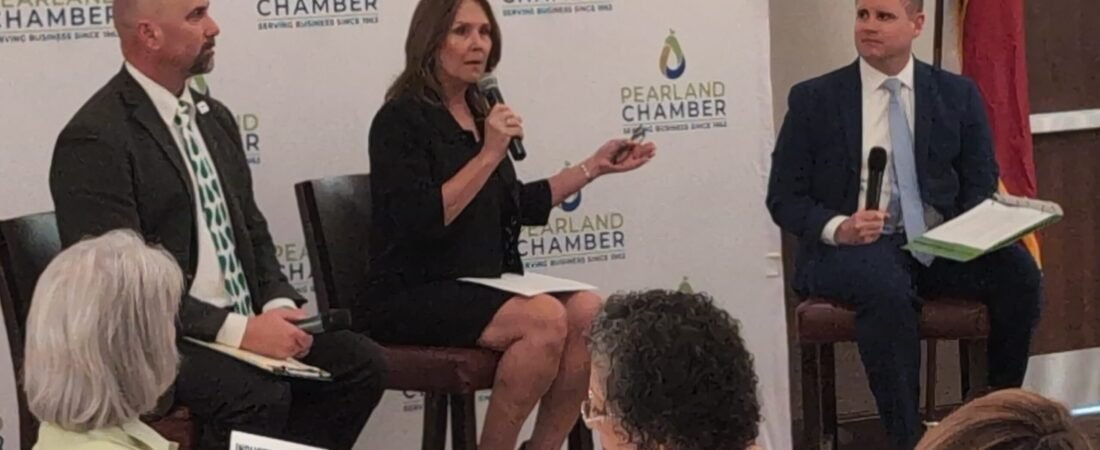
At the Pearland Chamber’s State of Education Luncheon, Alvin ISD Superintendent Carol Nelson and Pearland ISD Superintendent Dr. Larry Berger took part in a moderated conversation that touched on the pressures facing public schools, from funding and enrollment to technology, cell phones, and school choice. The discussion also underscored what both leaders said makes public education essential: relationships, community support, and a commitment to serving every student.
The program opened with a reminder that public schools are central to the community. Moderator Jim Johnson noted how public education plays a central role in the health of our community economy and helps prepare the next generation of workforce leaders and engaging citizens. That theme carried through the rest of the event as both superintendents described their districts and the challenges they are navigating.
One of the longest portions of the conversation focused on school finance, which both leaders described as complicated and frustrating. Nelson said school funding in the state of Texas just doesn’t happen in a simple, easy-to-explain way. “You can’t sit down with somebody and have an elevator speech and explain to them easily when something is that complex, so it builds a misunderstanding and it builds a mistrust.”
Nelson explained how districts are often expected to absorb state requirements without enough funding attached. “The state of Texas tells us you get this much money to educate kids,” she said, “and our kids don’t all come in with the same issues and same problems.” She pointed to safety costs as one example and said, “the state will tell you that you have to do X, Y, and Z, but the dollars don’t follow that.”
Berger echoed that concern saying “We get funded based upon the attendance of the students, not the number of students.”
He noted that Pearland ISD is losing about 200 students a year, but at the same time is serving more students who have greater needs. “When I go to my board and I say we’re declining enrollment by 200 kids, but I need to hire six more teachers, the math isn’t mathing… Each kid walks in with unique needs, and sometimes those unique needs require more staff, require more support, and a lot of that money that they’re talking about has been tagged and earmarked for other things that we can’t use with local control. It’s been designated. The frustrating part is the complexity of it and the fact that the headlines do not give those details.”
Berger and Nelson said enrollment also shapes budget planning. Nelson shared that Alvin ISD is still growing, but not at the pace it once did. “Each rooftop does not have students in it,” she said, adding that the district has to build its budget around projected enrollment, not hopes for dramatic growth. She said, “enrollment is your key factor when it comes to budgeting.” Berger said the same principle applies in Pearland ISD, where attendance and enrollment drive how much funding the district receives.
Technology became another major topic, focused on how classrooms changed after COVID. Berger said schools initially leaned heavily into digital learning, but eventually teachers and districts realized that too much screen time could weaken classroom connections. “The learning system has a built in grading system. It grades the lesson and puts it in the gradebook. That sounds great, right? Boom. Because what happens is, it’s a rotation of technology. There’s not the reflection piece, there’s not the humanness, there’s not the relationships… “The magic in education is not [technology] the magic in education is the relationship,” he said. He added that technology is useful, but only as a tool: “when is the best time to use technology not to replace what we had, but to support what we had? It is a tool.”
Nelson said she first saw the risks of technology when she was a school librarian and the internet became available. She said she could see children accessing material that was “not age appropriate” and “not socially appropriate,” and warned that smartphones and social media expose children to content they may not be ready for. She continued, saying, “It’s the worst thing we can do for kids is to allow them to be on social media when they’re not age appropriate.” To address artificial intelligence, she said Alvin ISD created an AI handbook and set guidelines for when students and teachers can use tools such as Gemini and Copilot.
On cell phones, both superintendents said limits were already improving school culture before the state law. Nelson said Alvin ISD restricted phones during instructional time because kids were on them constantly and they weren’t paying attention. She noted the result has been more interaction between students: “kids are talking more to one another. Now they’re looking at each other and having conversations. We have to keep reminding even teachers, you shouldn’t have your cell phones out in the classroom and on it continually, because what are you modeling for your students?”
Berger said the state mandate helped standardize what districts were already trying to do, but he still objected to the loss of flexibility. “It was one size fits all,” he said, adding that it “doesn’t work for anybody.” He said the policy removed “local control” and “discretion,” even if the practical outcome improved student behavior.
The conversation also turned to state mandates and how they strain district budgets. Nelson said many requirements are underfunded or unfunded, including safety, special education, counseling, and staff raises. She said districts are told to do more, but “the dollars don’t follow that.”
Berger agreed and said state leaders may have good intentions when they add new requirements, but the funding still falls far short of the actual cost. He said lawmakers can point to a safety allotment increase from $543,344 to $1,186,170 and say, “We doubled your safety. You loved it. You should be happy. Look at all the money we’re giving you.” But, he added, “Devil’s in the details, because with the new requirements Pearland ISD spends over $3 million just on safety.” He said that is why the requirement remains “one of the underfunded mandates that we have to absorb… and those pressures eventually hit the classroom and make it harder to balance priorities like staff compensation and operational needs.”
Moderator Jim Johnson asked the superintendents their thoughts on school choice and vouchers, describing how families have more options than ever including charter schools, private schools, and homeschooling: “The legislature recently passed a new voucher program providing roughly $10,000 in taxpayer funding for families to attend private schools. One of the concerns that has been raised by education leaders is that public schools are required to serve every student who walks through the door. That includes special education services, transportation, accountability, testing and a wide range of student support services. Private schools do not have to meet the same requirements and same standards and still retain the ability to pick which students they serve. So this is an important question about the role of public education. How do public school districts think about environment when public schools are asked to serve everyone while new policies are directly funding dollars and the systems that operate under a different set of rules?”
Both leaders emphasized that public schools carry broader responsibilities and greater accountability than private schools receiving voucher dollars.
Nelson said, “I think any public school official would say that vouchers are not good for our students,” but added she would never fault parents for making the best decision for their children.
She also tied that directly to accountability, adding that private schools may take public dollars without facing “the accountability that’s placed upon public schools.”
Nelson notably drew a clear line around access and equity, saying, “public schools serve all kids wherever they are, whatever their learning capabilities are, we have the responsibility to serve each and every child who walks through the door… Public schools provide all the services, extracurricular activities, excellent academics, and they prepare them for the future by giving students opportunities many private or charter schools cannot match.”
Berger said parents know their children best, but schools have to make sure families “don’t want to leave” by offering “the best academic education that they could possibly get anywhere.” He also argued that if the state expects public schools to compete, it must be “a fair playing field” with the same accountability standards.
The luncheon closed on a forward-looking note. Berger said education is about preparing students to be productive citizens and that the work depends on support from families, businesses, and the broader community. Nelson said she sees “hope” and “faith” in the next generation, adding that her grandchildren make her think about the future in a positive way. Berger said he remains optimistic because “the Pearland community shows up” when schools ask for help.