Water is not simply a utility expense for the Gulf Coast economy. For farmers, it determines whether crops can be grown. For manufacturers, it supports cooling, process operations, and reliability. For coastal communities, it is inseparable from resilience, environmental health, and the way development changes the landscape.
And as data centers become a larger part of the Texas economic-development conversation, the region is confronting a new set of questions: How much water will these facilities require, where will it come from, what will happen to their wastewater, and who will be responsible for providing clear answers before new projects move forward?
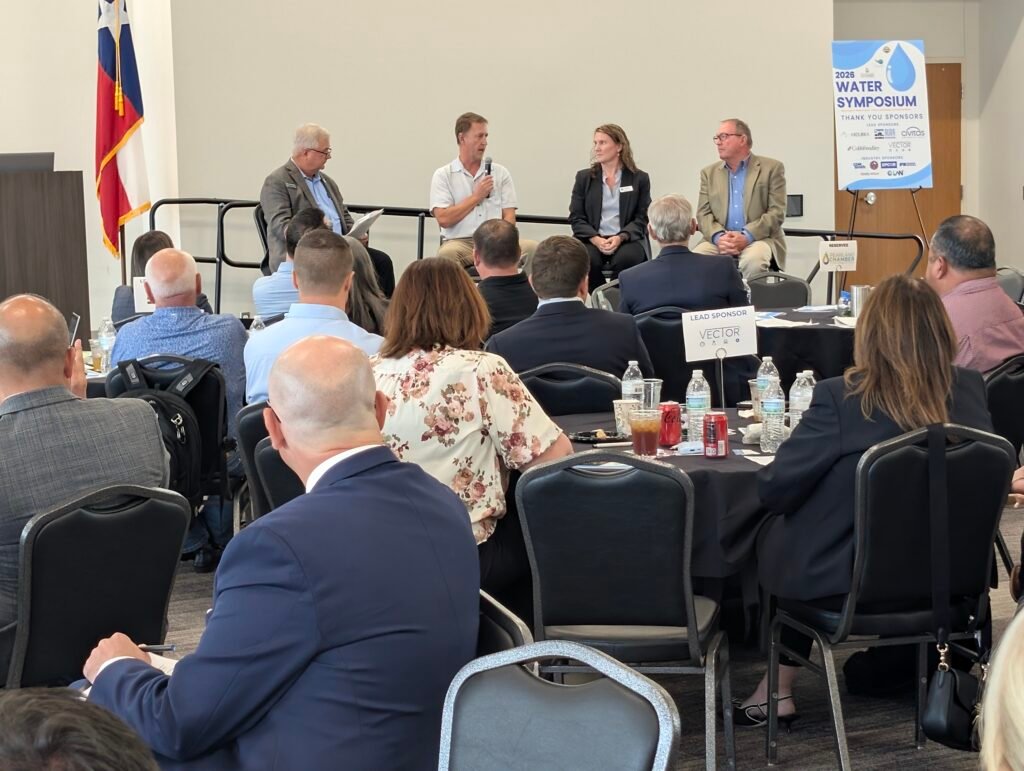
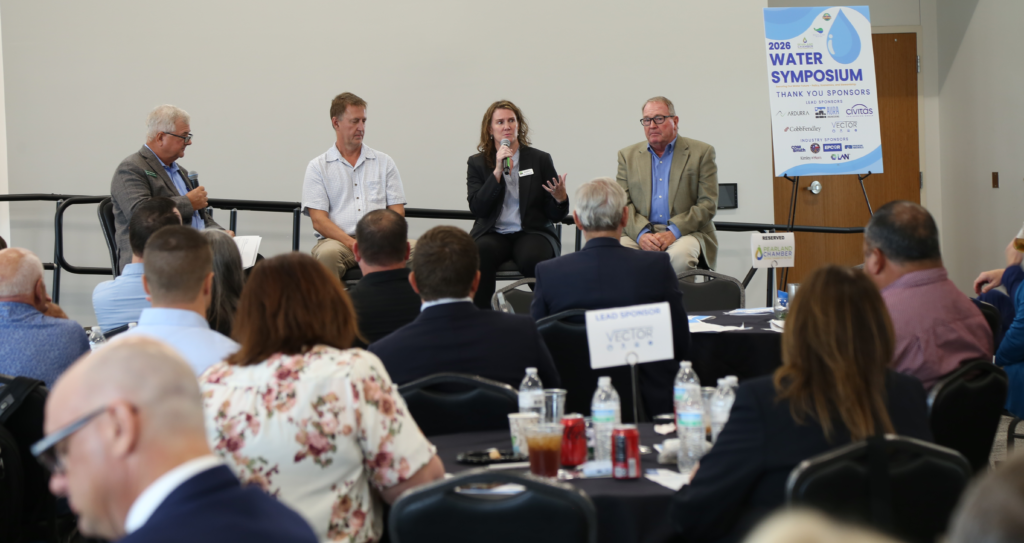
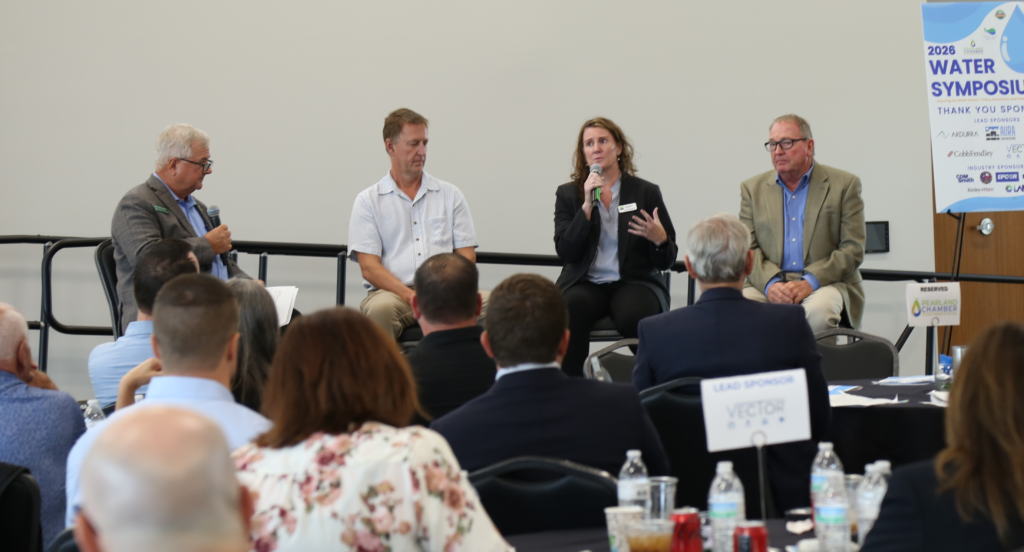
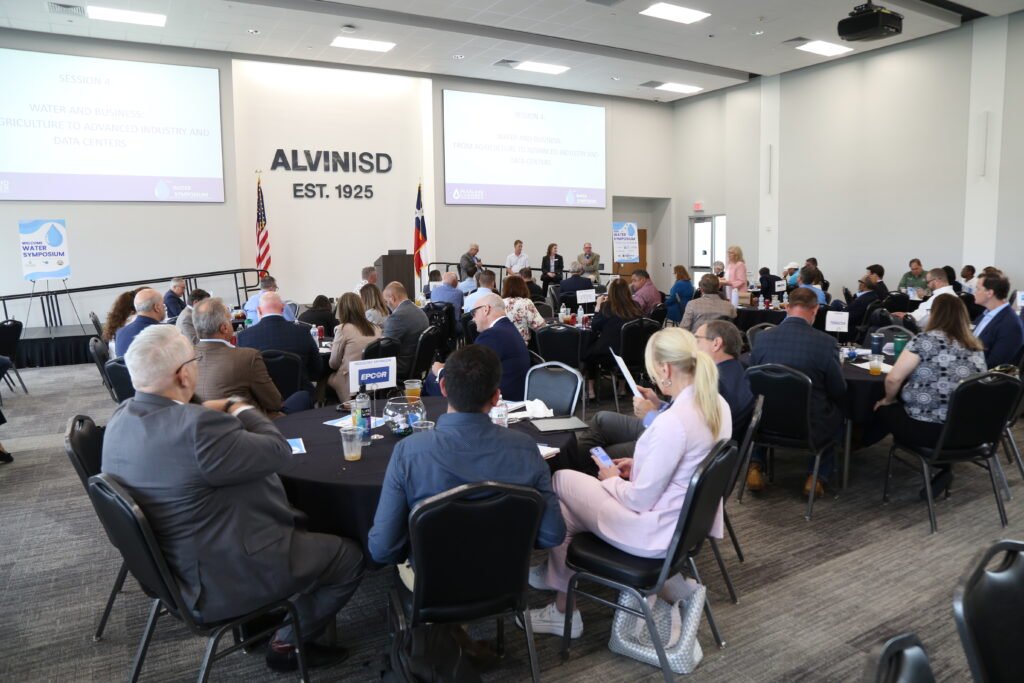
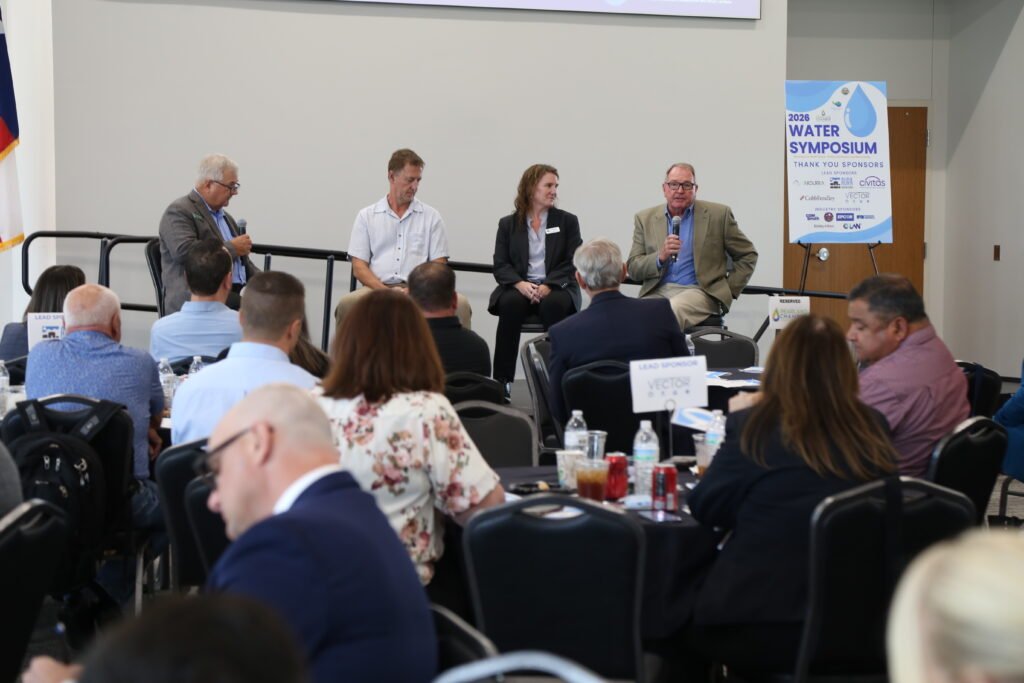
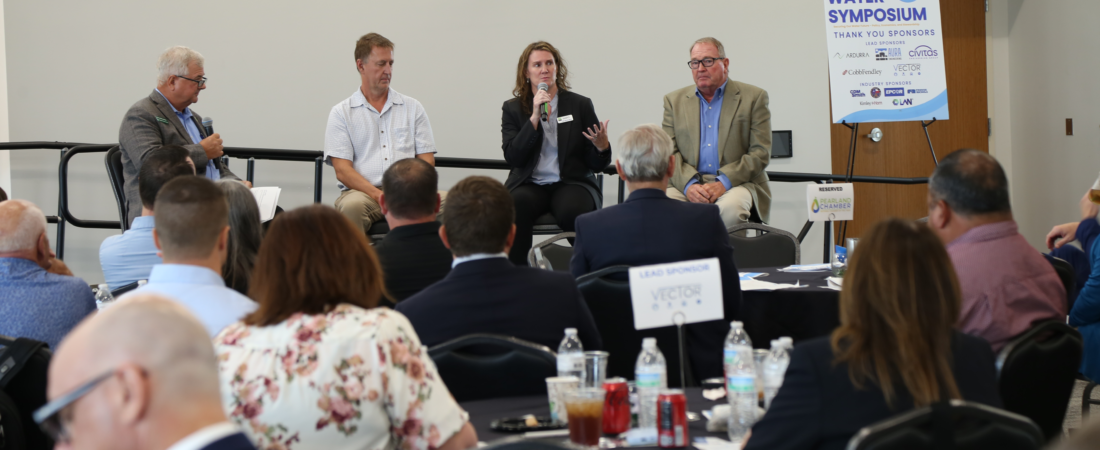
Those issues shaped Session 4 of the Pearland Chamber of Commerce’s 2026 Water Symposium, “Water and Business: From Agriculture to Advanced Industry and Data Centers.” Moderator Don Strouhal of Strouhal Turf Farms led a discussion with Gulf Coast rice farmer and Gulf Coast Water Authority Vice President Cliff Mock, Dr. Erin Kinney of the Houston Advanced Research Center, and Tim Finley, a senior manufacturing and engineering fellow at Dow Inc.
The panel did not present water as a conflict between agriculture, industry, technology, and the environment. Instead, it framed water as the shared resource underlying all of them, and as a planning challenge that becomes more complicated as the Gulf Coast grows.
Water is an economic necessity
Don Strouhal opened the session by emphasizing that water has different, but equally essential, roles across the region’s major economic sectors.
For agriculture, he said, “Water is not simply a utility cost for agriculture. It is a vital strategic component to each and every crop grown or animal raised.” When farmers cannot obtain enough water, production declines, livelihoods are threatened, and food prices can rise.
The same is true, in different ways, Strouhal noted, for petrochemical manufacturing, energy production, and other industrial activity. Water supports process operations, cooling, treatment, and reliability. It has also become part of the discussion around high-tech facilities, including data centers, which are increasingly viewed as important to the national economy and to Texas’ growth strategy.
That broad framing mattered because the panel’s speakers approached water from different perspectives. Mock represented agricultural producers and a regional water supplier. Kinney examined the links between water use, communities, and coastal ecosystems. Finley brought the perspective of a large industrial water user with decades of experience in water, wastewater, and cooling systems.
Their shared point was that the Gulf Coast cannot treat water planning as a separate issue from business planning, land use, infrastructure, or resilience.
Agriculture depends on reliability
For Gulf Coast agriculture, reliable water means the difference between a productive growing season and a loss.
Mock, a rice farmer and agricultural consultant who works with growers across the Gulf Coast, represented an industry that has long depended on regional water infrastructure. Rice, corn, soybeans, grain sorghum, turf, and other agricultural operations all require farmers to make decisions around water availability, timing, cost, weather, and crop risk.
The region’s agricultural systems also exist alongside fast-growing cities and expanding industrial areas. That changes the water conversation.
As land converts from farms to subdivisions, business parks, warehouses, or industrial sites, water demand does not disappear. It shifts. New development may create more year-round municipal demand, new infrastructure needs, and more pressure on the systems that once primarily served agricultural land.
The panel’s underlying concern was that agriculture should not be treated as an outdated part of the water system. It remains connected to regional food production, land management, rural economies, and the infrastructure that supports the Gulf Coast.
For farmers, water reliability is not an abstract policy question. It is a business condition that affects planting, yields, operating costs, and the ability to continue producing.
Industry sees water as a reliability issue
Finley brought a manufacturing perspective shaped by more than three decades of work on water, wastewater, and process-cooling challenges around the world.
For industrial users, he said, water planning is closely tied to reliability. Manufacturers need to know that water will be available at the required volume, quality, and time. They must also manage the water they use, the wastewater they generate, and the systems that support safe, continuous operations.
Finley’s background includes water-rights and reliability work in the Brazos and Guadalupe-San Antonio watersheds, as well as efforts to develop, design, and permit a 60,000-acre-foot off-channel reservoir in the lower Brazos basin. His experience reflects the scale of planning often required before water can support new industrial demand.
Finley spoke on how a facility may use water for cooling, manufacturing processes, boilers, cleaning, treatment systems, or other functions. “Some of those uses need high-quality water, while others may be compatible with reclaimed water, treated effluent, or another alternative source.”
He shared how that creates opportunities, but it also requires planning early enough to build the necessary infrastructure.
The larger question, he concluded, is not simply whether the region can recruit new industry. It is whether water supply, treatment capacity, reuse systems, discharge requirements, and long-term reliability have been considered before a project is promised water.
Coastal resilience must be part of the conversation
Kinney’s perspective connected water demand to coastal ecology, land use, and community resilience.
As a coastal watershed ecologist and senior research scientist at the Houston Advanced Research Center, Kinney studies how water use and distribution affect communities, aquatic environments, estuaries, and the coast. Her work focuses on the relationship between people, water systems, and the natural environments that sustain Gulf Coast communities.
She discussed how the region needs dependable supply for homes, farms, and businesses. At the same time, it must manage floodwater, drainage, drought, subsidence, water quality, coastal ecosystems, and development pressure. She added that a decision that appears to solve one problem can create another if it is not evaluated in the wider watershed and coastal context.
The panel’s discussion continued, and suggested that resilience is not only about having enough water during drought. Kinney explained it is also about understanding where water goes after it is used, how water quality is protected, how new development affects local systems, and whether communities have enough information to make sound decisions.
She said the need for better information was particularly relevant as the region considers emerging water demands.
Data centers bring unanswered questions
Data centers were one of the session’s most discussed topics. Panel members focused on how they introduce a fast-moving and poorly understood category of demand for resources.
Kinney said there are still major gaps in public information about data-center water use, noise, lighting, and wastewater. Communities are asking questions about proposed facilities, she said, but often do not have enough project-specific information to evaluate the answers.
The lack of clarity creates a problem for local decision-makers and residents.
She said a company may describe a proposed data center as having minimal water demand, but a community still needs to understand what that means in practice. “Even facilities that use less water than some conventional designs will have restrooms, fire-suppression needs, cooling systems, wastewater, and other water-related infrastructure.”
Kinney added that local authorities, utilities, permitting agencies, and others with approval authority need to be clear about what information they require before a project is allowed to proceed.
She also pointed to the effect of nondisclosure agreements. Companies may consider details about facility design, capacity, operations, and demand to be confidential. “Everybody’s hiding behind a nondisclosure agreement,” she noted. “But the public entities responsible for assessing water supply, wastewater treatment, power demand, and environmental impacts still need enough information to determine whether a project is appropriate for a particular location… This is not simply a transparency issue. It is a planning issue.”
She emphasized that if a city does not know the likely water demand, wastewater characteristics, cooling approach, and fire-flow needs of a major facility, it cannot accurately assess the infrastructure required to serve it.
Cooling choices shape water demand
Finley offered a technical explanation for why data-center water use can vary so widely.
How a facility is cooled depends in part on the temperature at which its equipment operates. “How you cool something ends up being a function of the temperature that you’re cool to,” Finley said. “If you have to cool something to, say, 40 degrees C, you almost have to cool with water in an evaporative effect. If you’re cooling something to 60 degrees C, you can actually air cool it cheaper than you can water.
That means technology choices can influence water demand.
Finley said substantial work is occurring within the data-center industry on cooling design. He suggested that some facilities could change approaches as technology evolves. “I do think there’s a space where it can move to kind of a relatively low water demand or no water demand,” he added.
But the tradeoffs do not disappear. Air cooling can require more fans, which can create noise concerns, he noted, saying the energy and infrastructure required for a particular cooling approach must also be evaluated thoroughly. In other words, reducing water use may shift impacts to electricity demand, equipment design, land use, or community concerns.
The panel did not present a single preferred technology. It emphasized that the public should ask specific questions rather than accept general assurances.
What cooling system will the facility use? How much water will it require under normal operations and during peak heat? Will it use potable water, reclaimed water, or another source? What happens during drought restrictions? How will its demands affect surrounding customers and infrastructure?
Those questions are especially important because Texas is seeing proposals for data centers far larger than previous facilities.
Wastewater is part of the calculation
The conversation also focused on what happens after water is used.
Finley noted that evaporative cooling does not make water-related impacts disappear. If a facility uses water in cooling towers, much of that water can evaporate, leaving behind concentrated salts and other dissolved materials.
That creates a wastewater-management question.
As water evaporates, the remaining water becomes more concentrated. The resulting blowdown, or wastewater discharged from a cooling system to control mineral buildup, may not be suitable for a conventional municipal wastewater-treatment system without additional evaluation or treatment.
Kinney said community members have raised concerns about where that wastewater will go and whether traditional treatment facilities are designed to handle it.
She added that the issue is not hypothetical, but said it goes directly to permits, wastewater infrastructure, water quality, and the capacity of local systems. “A project cannot be evaluated solely by looking at the water entering a facility. Communities also need to understand what comes out, whether it can be treated safely, and who will bear the cost of any additional treatment or infrastructure.”
Fire protection raised another concern
Large data centers may occupy enormous buildings with significant electrical equipment, server infrastructure, and related systems. An audience member asked how communities can know whether enough water will be available to fight a fire at one of these facilities.
Kinney said the question gave her pause because it had not been part of the earlier discussion. But it illustrated the broader point: “Water demand should not be evaluated only as a daily operating number.”
A facility’s total water and infrastructure needs may include cooling, sanitation, wastewater, construction, emergency response, and fire flow. Local governments, utilities, and fire agencies must understand those needs before approving major projects.
The question also reflects how quickly the technology landscape is changing. A region accustomed to evaluating traditional residential, commercial, agricultural, and industrial demand may need new standards and information requirements for advanced facilities with different operating patterns.
Better information before commitments
The panel concluded by agreeing the takeaway shouldn’t be that agriculture, industry, coastal interests, and data centers are competing for a fixed amount of water.
It was that each sector requires better planning, better information, and a clearer understanding of shared impacts.
For agriculture, they said the priority is dependable supply and the ability to continue producing food and crops in a changing region.
For industry, they noted the priority is reliability, operational resilience, and access to water of the right quality for the job.
For coastal communities and ecosystems, they said the priority is understanding how supply decisions, wastewater, development, and land use affect the wider watershed.
And for data centers, the immediate need is transparency about water demand, cooling technology, wastewater, fire protection, and the infrastructure needed to support large facilities.
Kinney again emphasized that the Gulf Coast’s water future will not be determined by one industry or one project. It will be shaped by whether the region asks the right questions before new commitments are made.
About this article
This is written based on the panel discussion: “Water and Business: From Agriculture to Advanced Industry and Data Centers,” at the Pearland Chamber of Commerce Water Symposium, Aug. 27, 2026.
The 2026 Water Symposium did not offer a single solution to Texas’ water challenges. Instead, it brought together people working from different parts of the same system: legislators who fund and shape policy, city managers who plan for local growth, water authorities that move and treat supply, researchers who study ecosystems and resilience, farmers who depend on irrigation and industrial leaders who manage water at scale.
Pearland Stories published five articles examining each session from the 2026 Water Symposium in depth:
Texas water history, drought risk and the debate over moving water across long distances
Gulf Coast water supply, subsidence, surface water, reuse and conservation
Desalination lessons from Corpus Christi and what they could mean for Texas
Agriculture, industry, coastal resilience and data-center demand
The legislative issues expected to shape Texas water policy in 2027