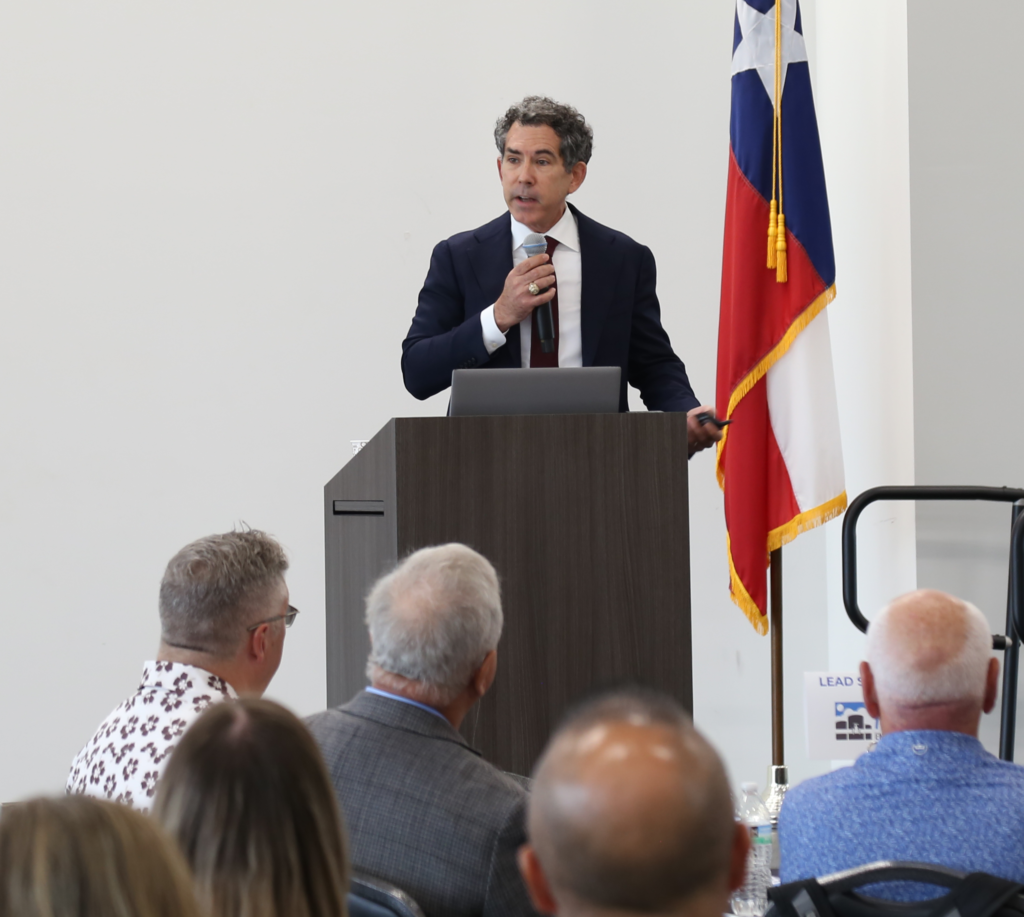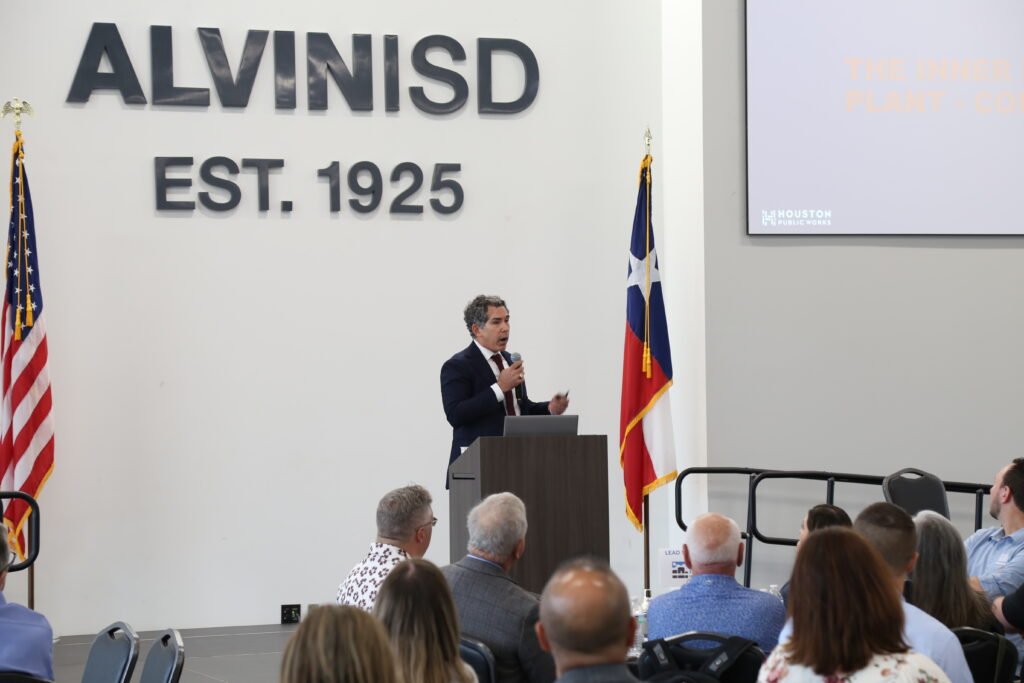
When Drew Molly arrived in Corpus Christi in 2022, the city was already deep into drought restrictions, reservoirs were falling, and a long-planned desalination project had reached a critical moment.
The engineering was not the hardest part.
Molly, now the chief water officer for Houston Public Works, spent three years as chief operating officer of Corpus Christi Water. His assignment was to help move the city’s proposed Inner Harbor desalination plant from planning into reality. The project had been studied for years, appeared in state water plans, had advanced through permitting and financing, and was intended to add a reliable, drought-resistant source of supply.
It did not get built.
Corpus Christi City Council ultimately voted to halt the project, despite years of planning and millions already spent on design, permitting, and development. Molly’s presentation at the Pearland Chamber of Commerce’s 2026 Water Symposium was not simply about desalination technology. It was about what it takes for a community to make long-term water decisions when those decisions carry real costs, public skepticism, environmental concerns, and political consequences.
His message for Texas was clear: Desalination may be a valuable part of the state’s water future, but a successful project requires public trust, clear communication, stable leadership, financing, permitting, and a shared understanding of the risk of doing nothing.
A city with water, but not enough certainty
Corpus Christi has a more diversified surface-water supply than many Texas cities. It receives water from three river basins, including the Nueces River Basin, Lake Texana, and the Colorado River.
That sounds like a strong position. The problem, Molly explained, is that every one of those sources is surface water.
Surface water can be plentiful in wet years and dangerously scarce in drought. Corpus Christi’s drought exposed the weakness of relying entirely on rivers and reservoirs, even when a city draws from multiple basins.
When Molly arrived, the city had already entered drought restrictions. In early 2026, Lake Corpus Christi was approximately 8.5% full. Choke Canyon Reservoir, a 650,000-acre-foot reservoir, had dropped to roughly 7.5% full. Heavy rains later improved some of those numbers, but Molly cautioned against treating a single major rain event as a permanent solution.
Lake Corpus Christi rose dramatically after rainfall, reaching roughly 91% full, but Choke Canyon saw a smaller increase. Lake Texana also faced strain before state action helped secure additional supply.
The experience illustrated one of the core themes of the Water Symposium: A water system cannot be judged only by how it performs during normal conditions. It must also be judged by how it performs when drought persists longer, reservoirs decline faster, or a major source becomes unreliable.
Corpus Christi’s supply challenge was compounded by its junior water rights on the Colorado River. That means the city can be vulnerable when more senior users claim available water. In a tight year, that can turn a seemingly diverse portfolio into a much less certain one.
The Inner Harbor project
Corpus Christi’s Inner Harbor desalination proposal was designed as a 30-million-gallon-per-day seawater desalination plant.
For Houston, which Molly said produces roughly 640 million gallons a day, 30 million gallons may sound modest. But for Corpus Christi, where demand was around 100 million gallons per day, the plant would have represented a major additional supply source.
The project would have treated seawater through reverse osmosis, a widely used technology that removes salts and other dissolved materials. Molly described desalination as a drought-proof supply because it does not depend on rainfall, reservoir levels, or river flows in the same way surface-water systems do.
The proposed water would not have been cheap. Molly estimated the cost at about $2,500 per acre-foot, or roughly $8 per thousand gallons. Corpus Christi projected that the project could produce an approximately 25% rate increase for customers using 5,000 gallons of water.
That rate impact became one of the central public concerns.
A 25% increase is not an easy sell, particularly when residents are already concerned about household costs. But Molly argued that the community also needed to consider what the investment would buy: a large, reliable source of water that could continue operating when drought puts rivers and reservoirs under stress.
The underlying question was not simply whether desalination costs more than conventional water. It was whether Corpus Christi could afford to wait until its existing supplies reached a breaking point.
Permits, financing, and industry support
By the time the project was halted, it had advanced well beyond a preliminary idea.
Molly said the project had secured the necessary permits, including approvals involving the Texas Commission on Environmental Quality, the U.S. Army Corps of Engineers, and federal environmental review. It had received approximately $757 million in low-interest financing through the State Water Implementation Fund for Texas, commonly known as SWIFT.
Corpus Christi had also issued roughly $232 million in low-interest bonds connected to the project before it was canceled.
Industry, which uses a significant portion of the city’s water, had agreed to contribute. Molly said industrial users had voluntarily committed to paying additional costs and were expected to provide approximately $200 million over the life of the project.
The city had selected a contractor and advanced through progressive design work. Molly said approximately $60 million had been spent before the project was paused.
The facts mattered because they illustrate how difficult it is to stop, restart, or redirect a major water project. By the time a desalination plant reaches construction-ready stages, a community may already have invested years of staff time, engineering, public engagement, environmental studies, bond planning, and regulatory work.
Why the project stalled
Molly did not place responsibility for the project’s failure entirely on Corpus Christi City Council. He said that as a city official, he also had a responsibility to ensure that decision-makers and residents had accurate, understandable information.
Still, his presentation identified several issues that made the project difficult to sustain.
The cost to residents
The projected rate increase was a major obstacle. Even if desalination offered a drought-resistant supply, customers would be asked to pay more before they experienced a visible emergency.
That is one of the hardest parts of water planning. Infrastructure can take years to build, which means communities must invest before the crisis arrives. But when reservoirs refill after rain, the perceived urgency can fade quickly.
Environmental concerns
The Inner Harbor project proposed discharging concentrated brine into a bay-connected channel. Brine is the saltier water left after freshwater is separated from seawater through reverse osmosis.
Some residents and environmental advocates raised concerns about the effect of discharge on the bay system. Molly said his team studied the issue and believed the project could manage discharge without significant environmental harm. He pointed to existing desalination facilities in Tampa Bay and California as examples of plants operating near sensitive marine environments.
Molly argued that offshore discharge may receive less scrutiny, but it also costs substantially more. The tradeoff was clear: A more expensive discharge route could reduce certain public concerns, but it could also increase rates further.
Confusion over multiple projects
Corpus Christi’s desalination debate became more difficult because several projects and entities were involved.
The city had the Inner Harbor project. The Port of Corpus Christi and other regional entities were also discussing or advancing separate desalination concepts. Molly said the proliferation of different names, locations, and sponsors made it harder for the public to understand who was proposing what.
When a community is trying to decide whether it supports an expensive project, confusion can become its own barrier. Residents may not know which project is being considered, how the projects differ, who would own them, or who would pay.
Disagreement over control
Molly also described debate over whether the desalination plant should be city-owned and city-operated, privately operated, or developed through another arrangement.
He said there are circumstances where a private model may make sense, but he believed Corpus Christi could have owned and operated the plant with the right training and staffing. Other officials did not share that view.
The ownership question was not a technical issue alone. It involved public confidence, governance, long-term costs, and who would be accountable for the facility over time.
The industry question
Industry uses a large share of Corpus Christi’s water, and that created another source of tension.
Molly said industry had agreed to contribute additional funding toward the project. Some residents, however, believed industrial users should carry a much larger share of the cost.
That debate is likely to surface in water discussions across Texas. Major industrial users can generate jobs, taxes, and economic activity, but they also depend on significant water supplies. Communities will increasingly have to decide how costs should be divided among residential customers, commercial users, industry, and public entities.
The lesson: Collaboration is the hard part
Molly’s strongest point was that building a desalination plant is not simply an engineering challenge.
“The engineering, the construction, the piloting, the permitting, and those things are all relatively straightforward,” he said. “A lot of times it comes down to getting along with people and collaborating.”
The statement captures the central lesson from Corpus Christi.
Water projects need technical expertise. They need permits. They need financing. They need reliable equipment and operators. But they also need political continuity, clear public communication, and agreement among cities, utilities, industry, environmental advocates, and residents.
Without that alignment, even a fully permitted, financed, and designed project can stop.
Molly said he still believes Corpus Christi will eventually build a desalination plant. He also believes Texas will increasingly turn to desalination as communities look for supplies that are less exposed to drought.
But the Corpus Christi experience shows that communities cannot wait until reservoirs are nearly empty to explain the need for a new source. By then, the public may be asked to make an expensive decision under pressure, with too little time to build trust or evaluate options.
What Houston’s water system can learn
Molly returned to Houston after Corpus Christi with a renewed focus on resilience, infrastructure, and water loss.
He said Houston has advantages that Corpus Christi does not. It has a large surface-water system, major treatment facilities, groundwater as part of its supply portfolio, and significant potential for reuse. The city is also expanding the East Water Purification Plant through a multibillion-dollar project.
But Molly added that Houston has its own vulnerability: water loss from aging infrastructure.
He said Houston lost approximately 40 billion gallons of water in the previous calendar year. The city had a backlog of roughly 1,900 water-line breaks when he returned, though that number had been reduced to about 150 through ongoing repair efforts.
The comparison matters because finding “new” water is not always about building a new reservoir or desalination plant. In some cases, repairing leaking pipes, replacing aging mains, and improving system efficiency can create a supply benefit equal to, or greater than, a new source.
Molly said Houston is also positioned to expand reuse. He described reuse as “the next water supply” because it allows a community to use water it has already treated rather than relying entirely on new withdrawals from rivers or aquifers.
Houston may also consider desalination in the future. But the city’s immediate work includes maintaining and rebuilding the systems it already has.
What it could mean for Texas
Desalination is unlikely to replace every traditional water source in Texas. It is energy-intensive, costly, and requires significant investment in treatment, intake, discharge, pipelines, and operations.
But the Corpus Christi story shows why it may become a larger part of the state’s portfolio.
For coastal cities, the Gulf of Mexico offers a supply that does not disappear during drought. For communities concerned about groundwater depletion or subsidence, desalination can provide an alternative to increased pumping. For regions dependent on stressed river systems, it can function as a backup supply.
The question is whether communities are willing to make the investment before a drought forces the issue.
Corpus Christi’s experience also offers a warning. Rain can ease a crisis, but it does not erase the long-term planning problem. A full reservoir today does not guarantee a reliable supply through the next prolonged drought.
The bigger lesson is that water decisions are rarely only about water. They involve trust, cost, growth, environmental stewardship, infrastructure, politics, and the willingness to prepare for a future that may still feel far away.
For Texas, desalination may be part of the answer. Corpus Christi showed how difficult it can be to turn that answer into a project the public is ready to support.
About this article
This is written based on the presentation: “Desalination: Separating Fact from Fiction,” by Drew Molly, Chief Water Officer for Houston Public Works at the Pearland Chamber of Commerce Water Symposium, Aug. 27, 2026.
The 2026 Water Symposium did not offer a single solution to Texas’ water challenges. Instead, it brought together people working from different parts of the same system: legislators who fund and shape policy, city managers who plan for local growth, water authorities that move and treat supply, researchers who study ecosystems and resilience, farmers who depend on irrigation and industrial leaders who manage water at scale.
Pearland Stories published five articles examining each session from the 2026 Water Symposium in depth:
Texas water history, drought risk and the debate over moving water across long distances
Gulf Coast water supply, subsidence, surface water, reuse and conservation
Desalination lessons from Corpus Christi and what they could mean for Texas
Agriculture, industry, coastal resilience and data-center demand
The legislative issues expected to shape Texas water policy in 2027