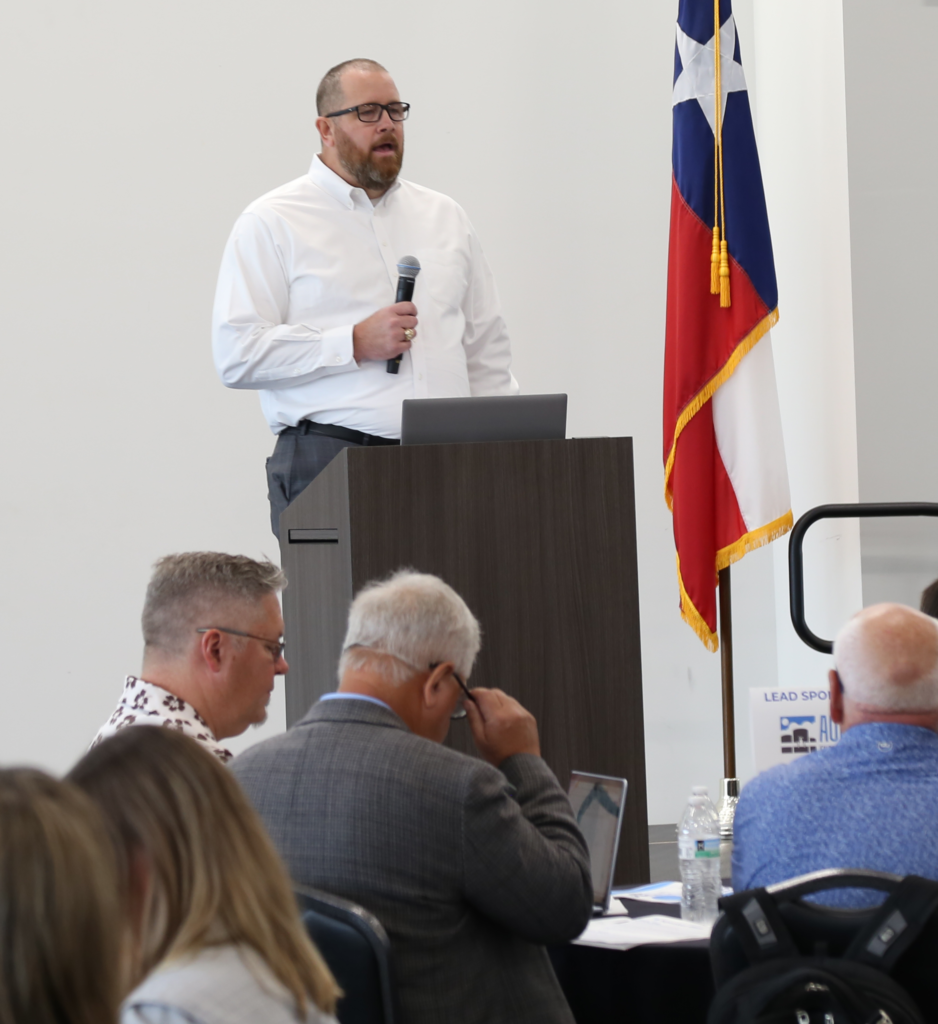
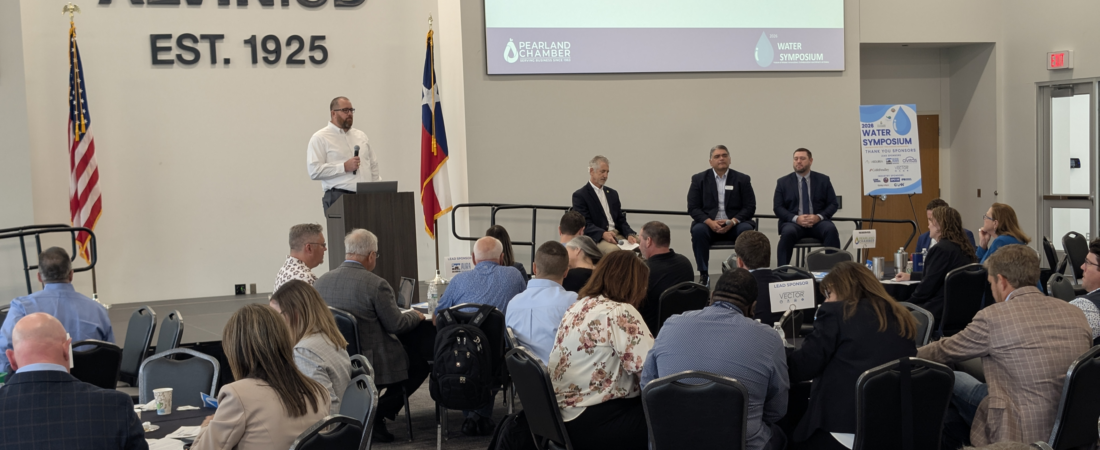
Pearland’s water supply is part of a far larger Gulf Coast system shaped by decades of planning, a necessary transition away from groundwater, and the challenge of making sure enough water is available when the region grows and drought arrives at the same time.
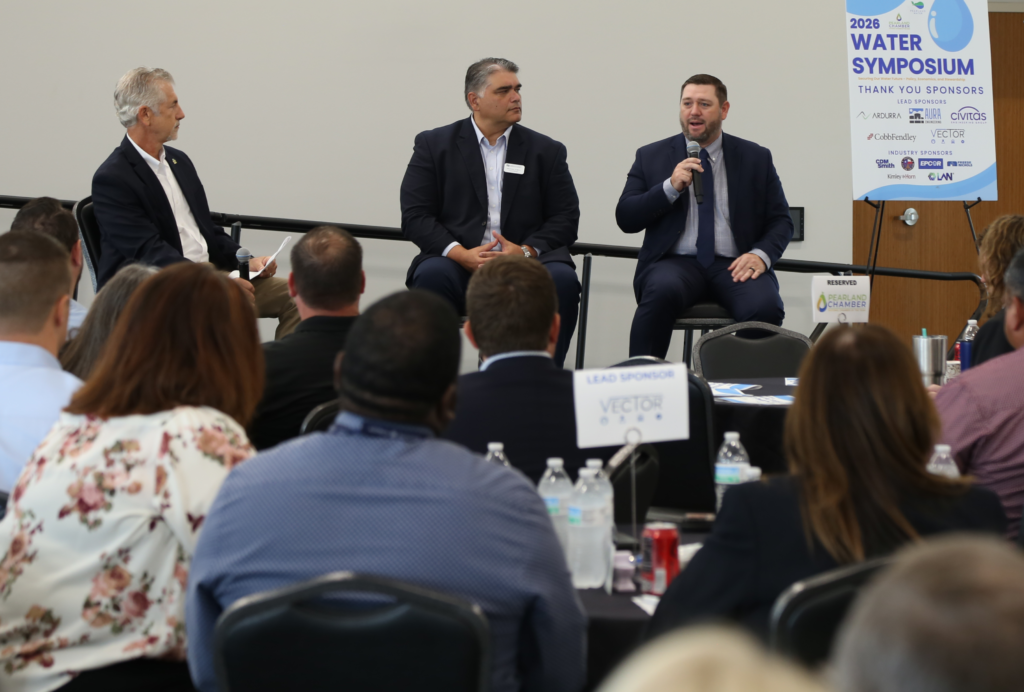
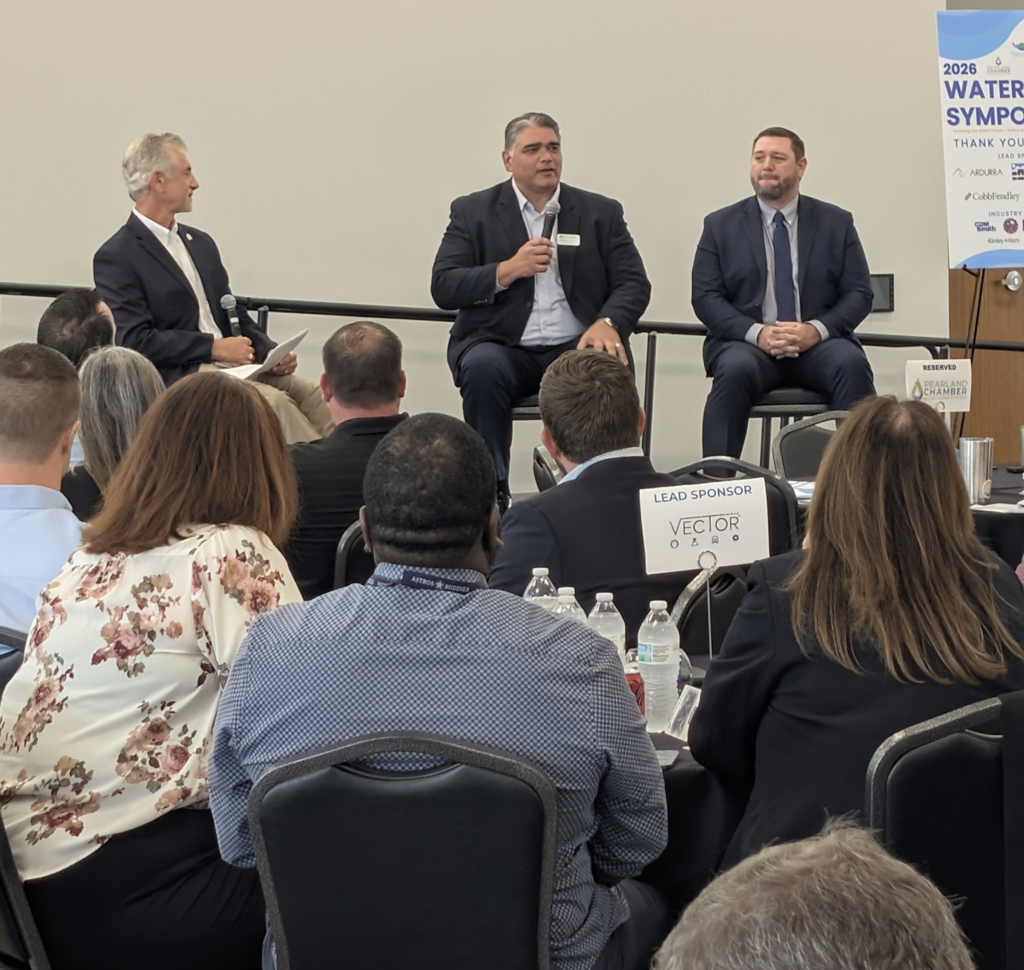
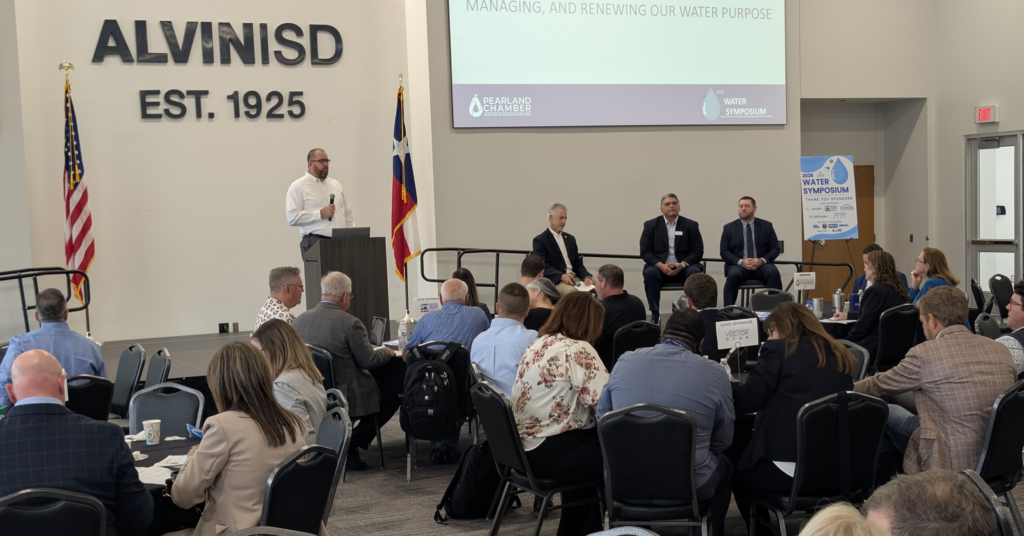
That was the focus of the second session at the Pearland Chamber of Commerce’s 2026 Water Symposium: “From Source to Sustainability: Capturing, Managing, and Renewing Our Water,” the discussion brought together Pearland City Manager Trent Epperson, who moderated the session; Jake Hollingsworth, MBA, deputy general manager and chief operating officer of the Gulf Coast Water Authority (GCWA); and Michael J. Turco, general manager of the Harris-Galveston Subsidence District and Fort Bend Subsidence District.
Their message was straightforward: There is no single solution to Texas’ water future. The region will need surface water, carefully managed groundwater, reuse, conservation, stormwater strategies, infrastructure maintenance, and eventually, perhaps, additional alternatives such as seawater desalination.
For Pearland, the discussion offered a reminder that the water arriving at homes and businesses is the result of planning decisions made years, and in some cases decades, before it reaches a faucet.
Why the region moved away from groundwater
Much of the Gulf Coast historically depended on groundwater. The Gulf Coast Aquifer is extensive, and for decades it supplied communities, farms, and industry across the region.
But intensive groundwater pumping came with a serious consequence: subsidence.
Subsidence is the sinking of land caused in part by removing large volumes of groundwater from underground formations. In low-lying coastal areas, it can increase flood risk, affect drainage, damage infrastructure, and contribute to property concerns.
Michael J. Turco, general manager of the Harris-Galveston Subsidence District and Fort Bend Subsidence District, explained that groundwater remains an important resource, but heavy reliance on it created problems the region could not ignore.
The Harris-Galveston Subsidence District was created by the Texas Legislature in 1975 to address the issue. The central strategy has been reducing dependence on groundwater and developing alternative supplies, particularly surface water.
The goal is not to stop using groundwater entirely. Turco said the region needs a portfolio approach because every supply source carries some level of uncertainty. Surface water can be affected by drought. Reuse requires infrastructure, customers, and investment. Desalination is expensive. Groundwater can serve as a reserve, but it must be managed carefully to avoid worsening subsidence.
That balancing act has become central to regional water planning.
The Gulf Coast Water Authority’s role
Jake Hollingsworth, MBA, Deputy General Manager and Chief Operating Officer of the Gulf Coast Water Authority (GCWA), described an extensive system built on long-term foresight.
The Gulf Coast Water Authority was established after community and industrial leaders in the Texas City and Galveston County area began looking for alternatives to groundwater in the mid-20th century. Today, the authority operates a network of canals, treatment systems, and water-delivery infrastructure that serves cities, industry, and agriculture.
The Brazos River is the backbone of that system.
GCWA diverts Brazos River water and sends it through approximately 176 miles of canals. The authority can deliver up to 200 million gallons per day through its contracted capacity. Municipal customers receive water through regional arrangements, while some cities treat raw water themselves before delivering it to their residents and businesses.
The authority also operates a surface-water treatment plant in Texas City that serves much of Galveston County. Its system supplies industrial customers, including major facilities in the Texas City industrial area, and still provides water for agriculture, including roughly 12,000 acres of rice during the first crop each year.
The discussion underscored that the Gulf Coast system is not limited to city water service. It is an interconnected network that supports homes, businesses, manufacturing, ports, agriculture, and economic growth across the region.
Hollingsworth also pointed to Pearland’s place within that system. The city has connections to Houston’s Southeast Water Purification Plant, and water conveyed through Pearland supports a broader network of communities. That regional connection is one reason local planning cannot be separated from the water decisions being made across Brazoria County, Galveston County, Harris County, Fort Bend County, and beyond.
Growth changes the math
The biggest long-term challenge discussed during the session was growth.
New residential development, industrial expansion, commercial activity, and population increases all create new water demand. But demand is not steady. Water systems must be prepared for peak periods, particularly during drought, when customers use more water and traditional supply sources may be strained.
Hollingsworth described the difficulty of planning capacity for those moments. Utilities must build enough infrastructure to meet future need without investing too far ahead of demand, which can raise costs for existing customers.
That is especially challenging in an area where land uses are changing rapidly. A canal or pipeline that once crossed agricultural fields may eventually run beside subdivisions, commercial sites, or industrial facilities. Maintaining and expanding systems in those areas requires technical expertise, coordination, construction planning, and public understanding.
The panel also identified workforce development as a practical challenge. Water treatment plants, canals, pipelines, and distribution systems do not run without trained operators, maintenance workers, engineers, and technicians.
Hollingsworth said utilities are working with schools, career fairs, and colleges to help people understand that water operations can provide stable, skilled careers. The systems are increasingly complex, and the people responsible for operating them are as necessary as the pipes, plants, and pumps themselves.
Surface water, groundwater, and a broader portfolio
The region’s shift to surface water has helped reduce the risk of subsidence, but surface water is not a simple replacement for groundwater.
Michael J. Turco noted how the Gulf Coast relies on several river basins and surface-water systems. Those supplies can be reliable, but they are also subject to drought, competing users, upstream conditions, and long-term changes in rainfall patterns.
Turco emphasized that groundwater remains part of the regional portfolio, even as subsidence districts seek to reduce its use. The goal is to use groundwater strategically rather than depend on it as the primary supply source.
This approach is often described as an “all-of-the-above” strategy. It includes:
• Surface water from rivers and reservoirs
• Groundwater managed to prevent additional subsidence
• Water reuse
• Conservation and efficiency
• Stormwater capture
• Aquifer storage and recharge, where feasible
• Seawater desalination
• Other alternative water-management strategies
The session made clear that no one of these options can carry the entire burden. The region’s future depends on combining sources and using them wisely.
Can stormwater become water supply?
Stormwater is often viewed as a drainage problem. When heavy rain falls, the urgent priority is moving water away from homes, roads, and businesses to reduce flooding.
But the panel discussed whether that same stormwater could also become part of a future water-supply strategy.
The concept is appealing: capture water during major rain events, store it, treat it, and use it later. But the speakers emphasized that it is complicated.
Stormwater projects and water-supply projects often have competing goals. Flood-control systems are designed to move water away quickly. Water-supply systems are designed to hold water for later use.
To turn stormwater into a dependable supply, a community needs land, storage, treatment capacity, transportation infrastructure, permits, and a plan for how to use the water after it is captured.
Turco pointed to the idea of off-channel reservoirs as one potential approach. These reservoirs can capture high flows during storms, store water, and create a future supply source. But the projects require significant space, funding, and coordination.
The discussion also touched on aquifer recharge, or intentionally moving water underground to replenish groundwater supplies. Turco said the Gulf Coast’s geology makes that difficult in many places because of clay layers and other subsurface conditions. The idea remains under discussion, but there is no broad, large-scale implementation in the area at this time.
Reuse: A growing opportunity
Water reuse was discussed as one of the region’s most promising tools, particularly for industrial needs and future development.
Reuse means taking water that has already been used and treated, then using it again for a purpose that does not require drinking-water quality. Industrial cooling, manufacturing, irrigation, and some other uses can potentially rely on reclaimed water rather than fresh groundwater or surface water.
GCWA already participates in a form of reuse. The authority purchases treated wastewater effluent from the City of Alvin, then uses that water within its system for industrial and agricultural customers.
The volume is limited, but the concept is important. Reuse can reduce pressure on traditional supplies and make the overall system more resilient.
The speakers said the challenge is matching supply with the right customers. A reuse project requires infrastructure to move the water, an end user that can use water of that quality, and an economic reason to build the project.
Reuse is often easier to plan for in a new development than in an existing neighborhood or commercial district. Installing separate pipes and connections before construction is complete can be far less expensive than trying to retrofit a built-out area later.
Turco noted that reuse can be particularly valuable as industrial demand grows. Manufacturing, cooling systems, and other industrial processes may need substantial water volumes, and reuse can help preserve higher-quality fresh water for uses that require it.
Conservation begins with what is already there
The panel also stressed that the most valuable water may be the water the region already has in its system.
That means tracking water carefully, finding leaks, repairing infrastructure, and improving how water is used outdoors.
GCWA has expanded its ability to measure water moving through its open-canal system, a more complicated task than metering water through pipes. The authority has also used aerial and satellite-based analysis to identify soil moisture changes around pipelines that may point to leaks or other system issues.
According to the panel, those efforts have helped identify potential non-revenue water losses and significant financial savings for customer cities.
Turco focused on outdoor irrigation as one of the clearest areas for conservation. Residential and commercial irrigation can use large amounts of water, especially during hot, dry periods. He pointed to the Water My Yard program, which helps users adjust watering schedules based on weather, soil, and plant needs.
The basic idea is simple: Watering less often, and more appropriately, can save money for individual customers while preserving supply for the broader system.
Planning for what comes next
The session ended with both concern and confidence.
Turco said the region must continue looking far enough ahead. The Gulf Coast benefits today from decisions made by earlier generations of leaders who invested in water infrastructure before demand reached its current level.
The risk, he said, is becoming too focused on immediate needs and failing to prepare for the next generation of growth.
Hollingsworth expressed confidence in the region’s engineering capacity, water professionals, utilities, and existing infrastructure. But he also emphasized that water planning must operate decades ahead of demand.
The challenge is not only identifying new sources. It is making the long-term decisions necessary to pay for them, build them, operate them, and connect them to the communities that will need them.
For Pearland, the message was particularly relevant. The city has grown because of long-range investments in water supply and infrastructure. Continuing that success will require the same approach: understanding the region’s risks, diversifying supplies, reducing losses, investing in systems, and working with neighboring communities before the next challenge becomes a crisis.
About this article
This is written based on the panel discussion “From Source to Sustainability: Capturing, Managing, and Renewing Our Water,” at the 2026 Pearland Water Symposium panel discussion, Aug. 27, 2026.
The 2026 Water Symposium did not offer a single solution to Texas’ water challenges. Instead, it brought together people working from different parts of the same system: legislators who fund and shape policy, city managers who plan for local growth, water authorities that move and treat supply, researchers who study ecosystems and resilience, farmers who depend on irrigation and industrial leaders who manage water at scale.
Pearland Stories published five articles examining each session from the 2026 Water Symposium in depth:
Texas water history, drought risk and the debate over moving water across long distances
Gulf Coast water supply, subsidence, surface water, reuse and conservation
Desalination lessons from Corpus Christi and what they could mean for Texas
Agriculture, industry, coastal resilience and data-center demand
The legislative issues expected to shape Texas water policy in 2027