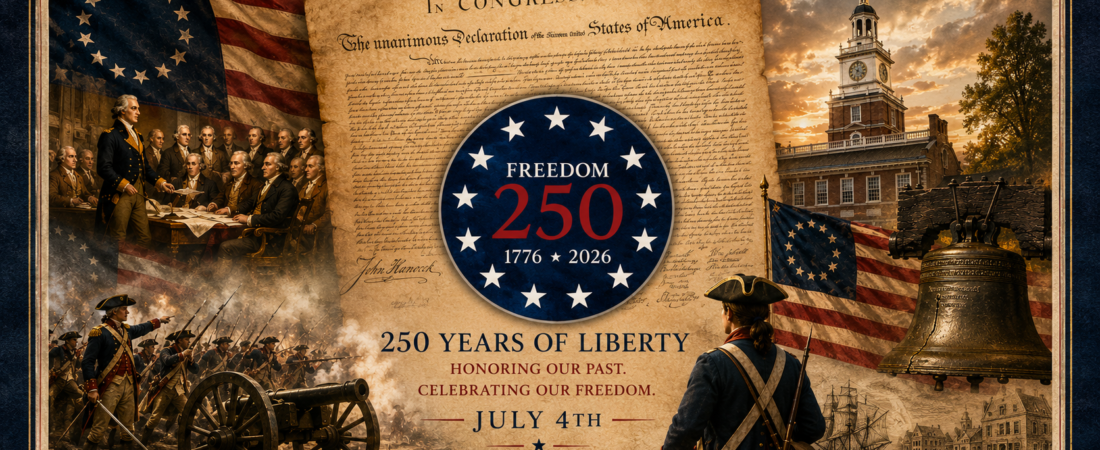
Two hundred and fifty years after the Declaration of Independence was adopted, this July 4 is a solemn milestone that calls us to remember that the freedoms we enjoy were hard won and that liberty is something we are entrusted to protect, not simply inherit.
On this date in 1776, Congress debated and approved the text of the Declaration, then ordered it printed and distributed to announce the colonies’ break from British rule. The famous parchment copy most of us picture was prepared later, with delegates beginning to sign it on August 2 and continuing into early 1777.
Independence Day therefore commemorates the moment the Declaration was formally adopted as the nation’s founding statement, not the day every signer put ink to parchment, and that distinction only deepens the meaning of this 250 year anniversary.
How July 4 Began
On July 4, 1776, the Second Continental Congress formally adopted the Declaration of Independence, announcing that the thirteen American colonies would no longer be ruled by Great Britain. The document argued that all people possess inherent rights and that governments exist to secure those rights, not to grant them. Within days, the Declaration was read publicly in Philadelphia and printed in newspapers, spreading its language and its bold ideas across the colonies.
Almost immediately, people began to mark the anniversary. In 1777, Philadelphia adjourned Congress for the day and celebrated with bonfires, bells, and fireworks, signaling that this new nation intended to remember its break from the British Crown in very public ways. Other towns soon followed, using parades, public readings, and gatherings to turn independence from a political decision into a shared civic ritual. These early celebrations helped fix July 4, rather than July 2, in the public mind as the birthday of the United States.
Path to a Federal Holiday
For decades, July 4 was a widely observed tradition but not an official national holiday. Communities organized processions, speeches, games, and fireworks on their own, especially after the War of 1812, when the young nation felt more established and eager to celebrate its survival and growing unity. The day took on added symbolic weight when John Adams and Thomas Jefferson, two key authors of independence, both died on July 4, 1826, exactly fifty years after the Declaration.
Congress eventually moved to recognize what people were already treating as a major national occasion. In 1870, lawmakers formally established Independence Day as a federal holiday, though at first it was unpaid for federal employees. It was part of a bill that acknowledged several widely celebrated dates, effectively codifying the Fourth of July as a national observance. In 1938, Congress made July 4 a paid federal holiday, putting it alongside other major civic and religious observances. Later adjustments in the twentieth century clarified how the holiday would be observed when it fell on weekends, underscoring its firm place in the federal calendar and in American life.
Traditions and Purpose Over Time
From the beginning, July 4 has been both celebration and reflection. Early observances featured public readings of the Declaration, patriotic speeches, and military displays, reminding citizens why the nation existed and what it stood for. Over time, those practices blended with more informal traditions: picnics, cookouts, concerts, and elaborate fireworks shows. Communities adopted parades through downtown streets, band performances in parks, and local festivals that mix civic ceremonies with family friendly fun.
Food and fireworks became central symbols. Fireworks echoed the look and sound of wartime cannon fire but transformed it into artistry and entertainment, a way of remembering conflict while celebrating peace. Sharing meals, whether at home or in public spaces, became a sign of community and abundance, especially as the nation grew more prosperous. Even as the holiday gained a more relaxed, recreational feel, many ceremonies kept core elements such as the Presentation of Colors, the National Anthem, and opportunities to honor veterans, first responders, and civic leaders.
The purpose behind the day has also evolved. In its earliest years, Independence Day primarily celebrated the break from monarchy and the birth of a new republic. As the United States confronted issues like slavery, civil war, civil rights, and waves of immigration, July 4 became a moment to wrestle with the gap between founding ideals and lived reality. Writers, activists, and leaders have used Independence Day addresses to call attention to that tension and to urge the country toward a fuller realization of liberty and justice for all.
The 250 Year Milestone
A quarter millennium is long enough to see the United States transformed from a collection of coastal colonies into a large, diverse nation whose decisions ripple across the world. It invites a wider view of history, one that holds both achievements and failures together.
This milestone highlights how extraordinary it is for a constitutional democracy to endure for 250 years. It underscores that the freedoms many Americans treat as ordinary are, in historical terms, unusual and fragile. The right to speak, worship, assemble, vote, and pursue opportunity depends on institutions, laws, and shared norms that have to be renewed with each generation.
The anniversary invites communities to look back at the courage required in 1776, the sacrifices offered in subsequent wars, and the civic work done by countless people who fought to extend the promises of the Declaration to those who were originally excluded.
Marking 250 years also raises questions about the next century. Independence Day this year is not only about looking back at what the founders did; it is about considering what today’s citizens will do with the freedoms they inherited. It challenges Americans to ask how they will strengthen trust in each other, protect democratic processes, and create communities where more people can flourish.
Precious Freedoms and Military Service
Underlying every July 4 celebration is a basic truth: freedom is costly. The decision to declare independence in 1776 led directly to war, and from that point forward the preservation of American self governance has depended on people willing to serve and, at times, to risk their lives. Members of the armed forces have stood at the front lines of that responsibility, defending the country from external threats and, in many cases, securing the conditions necessary for democratic life to continue.
On this 250th anniversary, expressions of gratitude carry particular weight. The longevity of American independence owes much to generations of service members who answered the call in conflicts from the revolution to the present day. Their sacrifices have protected not only territory and institutions, but the everyday freedoms people experience in ordinary life: the ability to speak without fear, to gather in public spaces, to vote for leaders, to worship according to conscience, and to raise families in relative safety.
Recognizing their role means more than brief ceremony. It involves telling the truth about the burdens they carry, supporting them and their families when they return home, and ensuring that civic decisions honor the cost of their service. When communities pause during Independence Day events to thank veterans and active duty personnel, they are acknowledging that fireworks and festivities rest on a foundation built, in part, by those who put uniform and duty ahead of comfort.
As the nation celebrates 250 years of independence, the Fourth of July invites Americans to hold together several realities: deep gratitude for the freedoms they enjoy, honest awareness of the work still unfinished, and renewed respect for those who serve to keep those freedoms possible. It is a day to remember that liberty is not guaranteed by tradition alone. It survives when citizens value it enough to protect it, nurture it, and pass it on, in better condition, to the generations who will mark future anniversaries.
If you’re interested in history, there are a few regional resources you can visit to learn more.
Brazoria County Historical Museum
The Brazoria County Historical Museum in Angleton serves as the primary historical resource center for the county, including the land that later became Pearland. It houses the Adriance Library and Research Center, which maintains extensive genealogical and photographic holdings and draws researchers from across the United States.
The museum’s collections include an “Old 300” database listing settlers who received land grants in Stephen F. Austin’s Colony by the eve of the Texas war for independence from Mexico, plus ancestors and descendants of those settlers. The museum also supports research through cemetery records, subject files, and an online collections database where visitors can browse artifacts and images before requesting more information from staff.
Brazoria County Library System
The Brazoria County Library System offers a strong set of genealogy tools that Pearland residents can access with a library card. Inside the library, patrons can use Ancestry Library Edition for census, vital records, and military files, including service records that may link to independence era ancestors.
Online, HeritageQuest provides access to federal census records from 1790 to 1940, Revolutionary War files, and family and local histories. The system also points to historical maps of Texas broken down by city and county, which can help families visualize where their ancestors lived and how county boundaries shifted over time.
Pearland Historical Society
The Pearland Historical Society focuses specifically on preserving the city’s story, from its late 1880s founding through modern growth. The organization maintains archives that include early settler journals, photographs, papers, and even architectural blueprints, offering a tangible connection to the community’s past.
The society’s mission is to safeguard artifacts, conduct academic research, and share Pearland’s heritage through educational programs and events. For your article, you can position the society as the best “first stop” for anyone curious about how Pearland itself grew from a small settlement by the railroad depot into the diverse city that now hosts events like Celebration of Freedom.
Happy Independence Day