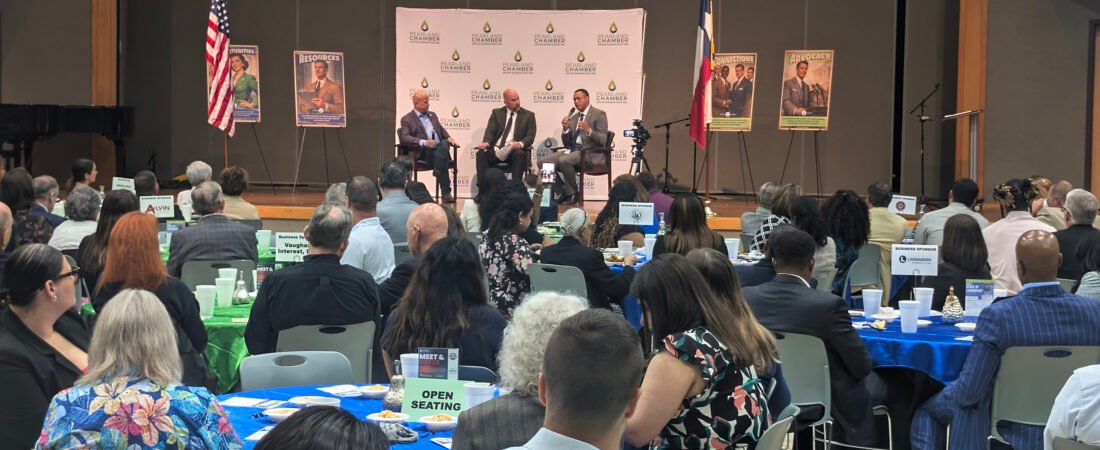
The Pearland Chamber of Commerce’s May luncheon wasn’t set up to be a political event, and it didn’t feel like one. It felt layered. Elected officials, business owners, school leaders, and longtime residents all sitting at the same tables, not just listening but recognizing themselves in the conversation. There was a sense that this wasn’t just about introducing a new mayor or thanking a former one. It was about taking a moment to look at Pearland from two vantage points at once. One shaped by decades of decisions that built the city people rely on today. The other shaped by the responsibility of carrying that forward in a way that still feels like Pearland to the people who call it home.
Newly elected Mayor Quentin Wiltz and outgoing Mayor Kevin Cole sat down for a moderated discussion that, at its best moments, felt less like an interview and more like two perspectives meeting in the middle of the same story.
Early on, both were asked to describe Pearland in one word.
Cole went first.
“Family.”
He didn’t leave it there.
“Look around this room. This is part of Pearland’s family… Council is a family. Staff is a family… Family is what Pearland is all about.”
It’s a simple answer, but it carries more weight coming from someone who has spent decades in public service here. Cole’s reflections throughout the conversation consistently pointed back to that idea. Relationships first. Systems second.
Wiltz followed with a different word.
“Opportunity.”
“For families… for jobs… for quality of life,” he said. “When we moved here 20 years ago, it was for opportunity.”
That contrast, family and opportunity, ended up framing most of what followed.
Cole spoke from a long view of the city. He talked about decisions made years, even decades ago, particularly around water infrastructure. Investments that most residents never see but depend on every day.
“I got to cut the ribbon on a plant that I had a hand in creating over 30 years,” he said. “I can’t think of a more consequential piece of infrastructure that will give life to our community.”
Wiltz, stepping into the role, focused less on physical infrastructure and more on how the city functions as a community.
“I see my involvement as building the infrastructure that you can’t see,” he said. “Alignment… understanding… the values that allow us to move forward together.”
That distinction matters, especially for a city like Pearland that has grown quickly and continues to evolve. Growth brings options, but it also brings complexity. Different expectations. Different experiences. Not always a shared sense of direction.
Wiltz acknowledged that directly.
“Now that I’m on the other side of the fence, there are expectations,” he said. “It’s really about setting the right expectation for people in the community.”
It’s the kind of comment that reflects the shift from campaigning to governing.
Cole’s advice, by comparison, was straightforward.
“Show up.”
He talked about the range of moments that come with the role. From recognizing residents celebrating 100-year milestones to spending time in local schools. For him, leadership was less about visibility in big moments and more about consistency across small ones.
Later in the conversation, both were asked what makes Pearland distinct.
Cole described it as “the largest small town in America,” pointing to something many residents would recognize.
“I’ve never seen a need not met in this community,” he said. “But people have to let others know.”
Wiltz focused on the city’s range. How different parts of Pearland offer different experiences without losing a shared identity.
“In Pearland, you find what you want,” he said. “You can’t find that in a lot of places.”
That idea, that Pearland doesn’t fit neatly into one category, is part of what makes it work. It is also part of what makes it harder to lead.
As the discussion turned toward growth, Cole offered a practical way to think about unity in a city that continues to expand.
He challenged the habit of dividing Pearland into “east side” and “west side.”
“We are one Pearland,” he said. “If we stay connected as a community, there is nothing we can’t do.”
It was a small point on the surface, but one that speaks to a larger reality. How a community talks about itself often shapes how it functions.
The conversation closed with a final prompt. “I’m Pearland Proud because…”
Wiltz answered from where the city is going.
“I’m Pearland proud because the opportunity that awaits us is so much greater than the opportunity that we left behind.”
Cole answered from what has already been built.
“I’m Pearland proud because we’re the number one city in the state of Texas… and it wasn’t one person. It was the whole community coming together.”
What came through most clearly wasn’t a contrast between two leaders, but a shared understanding of the responsibility that comes with this city. One has spent years helping build the foundation. The other is stepping in with a focus on how people experience what’s already here and what comes next.
That kind of handoff doesn’t reset anything. It adds to it. And if Pearland continues to be a place where people show up, stay connected, and take ownership of where they live, then whatever comes next will feel less like a shift and more like a city continuing to become what it has been building toward all along.
Pearland Mayors Meet for a Conversation on Leadership and Community